

A price tag can change how quickly a product flies off the shelf. Raise the price of a popular item, and some customers may think twice before buying it. This brings us to an important economics question: what happens to demand when price increases?
In most situations, demand falls when the price of a product or service goes up, assuming other factors remain unchanged. This basic relationship is known as the law of demand. However, the real world is a little more complicated. The size of the change can depend on income, available alternatives, consumer preferences, and whether the product is a necessity or a luxury.
What Happens to Demand When Price Increases?
Generally, when the price of a good rises, consumers buy less of it. When the price falls, consumers tend to buy more.
For example, imagine a coffee shop increases the price of a regular coffee from $3 to $5. Some customers may continue buying it because they love the coffee or have few alternatives. Others may switch to another café, make coffee at home, or simply buy coffee less often.
The important point is that price and quantity demanded usually move in opposite directions.
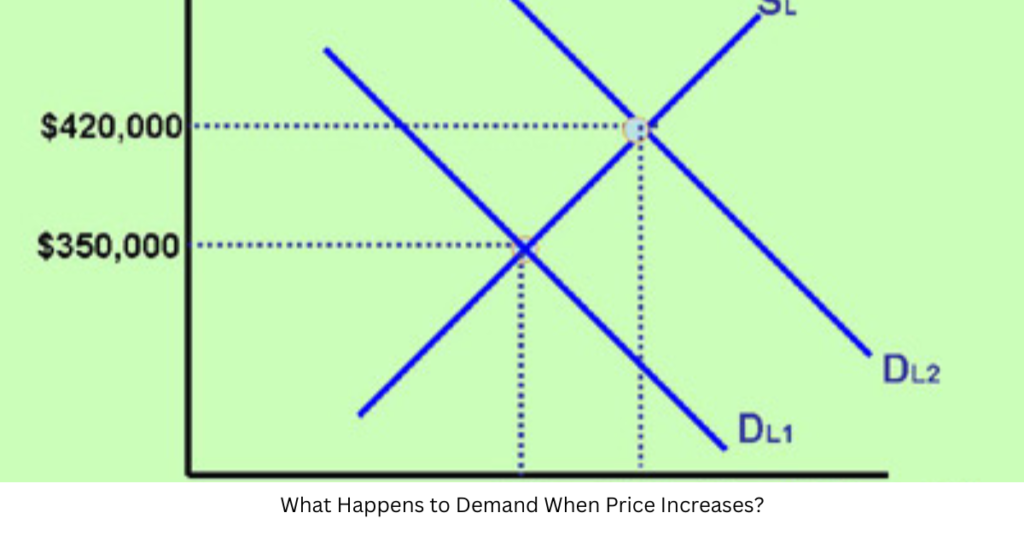
Economists illustrate this relationship with a downward-sloping demand curve. As the price moves higher, the quantity consumers are willing and able to purchase generally decreases.
Understanding the Law of Demand
The law of demand is one of the foundations of economics. It states that, all else being equal, an increase in price leads to a decrease in quantity demanded, while a decrease in price leads to an increase in quantity demanded.
The phrase “all else being equal” matters.
Suppose the price of a particular smartphone increases. If consumers’ incomes, preferences, competing products, and expectations remain unchanged, the higher price will generally result in fewer units being purchased.
The relationship can be summarized simply:
- Price increases → quantity demanded usually decreases
- Price decreases → quantity demanded usually increases
This does not mean every customer stops buying. It means the total quantity demanded in the market tends to decline.
Why Do People Buy Less When Prices Rise?
There are several economic reasons behind this behavior.
1. The Substitution Effect
When a product becomes more expensive, consumers often look for alternatives.
For instance, if the price of one brand of bottled water rises sharply while competing brands remain affordable, shoppers may switch brands. If bus fares increase, some commuters might consider cycling, carpooling, or using a train where available.
This is called the substitution effect.
2. The Income Effect
A higher price also reduces what consumers can effectively afford with their existing income.
Imagine someone has $100 available for groceries. If several everyday products become more expensive, that same $100 will purchase fewer items. The consumer may respond by reducing purchases or choosing cheaper options.
This is known as the income effect.
3. Consumers Have Limited Budgets
Most people cannot spend unlimited amounts of money. Businesses face similar constraints.
When prices rise, buyers have to prioritize. They may continue purchasing essential goods while cutting back on optional purchases such as entertainment, premium products, or expensive restaurant meals.
Price Increase vs. Change in Demand
There is an important distinction that students and business owners often overlook: a change in price usually causes a change in quantity demanded, not a shift in demand itself.
Think of a demand curve as showing how much consumers are willing to buy at different prices.
If the product’s own price changes, consumers move from one point on the curve to another.
A shift in demand, on the other hand, happens when something other than the product’s own price changes.
Factors that can shift demand include:
- Consumer income
- Tastes and preferences
- Population size
- Prices of substitute products
- Prices of complementary products
- Consumer expectations
- Advertising and brand perception
For example, if a celebrity endorsement suddenly makes a particular shoe fashionable, demand for the shoe may increase even if its price has not changed.
How Elasticity Changes the Outcome
Not every product experiences the same drop in sales after a price increase. This is where price elasticity of demand becomes important.
Elasticity measures how strongly quantity demanded responds to a change in price.
The basic formula is:
Price Elasticity of Demand = Percentage Change in Quantity Demanded ÷ Percentage Change in Price
Depending on the result, demand can be described as elastic, inelastic, or unit elastic.
Elastic Demand
Demand is considered elastic when consumers respond strongly to a price change.
For example, suppose a hotel increases its room rates significantly during a period when many competing hotels have similar rooms at lower prices. Customers may easily choose another hotel.
Products with many substitutes often have relatively elastic demand.
Inelastic Demand
Demand is inelastic when quantity purchased changes only slightly after a price change.
Essential goods can sometimes demonstrate this behavior. If a necessary medication becomes more expensive, patients may still need to purchase roughly the same amount.
That does not mean the price increase has no effect. It means the percentage change in quantity demanded is relatively smaller than the percentage change in price.
Unit Elastic Demand
Demand is unit elastic when the percentage change in quantity demanded is equal to the percentage change in price.
This concept is particularly useful when economists analyze how price changes affect total revenue.
What Happens to Total Revenue?
For businesses, the effect of a price increase isn’t simply about selling fewer products. Companies also need to consider total revenue.
The basic formula is:
Total Revenue = Price × Quantity Sold
Consider a simple example:
- Original price: $10
- Original sales: 1,000 units
- Original revenue: $10,000
Now imagine the company raises the price to $12.
If sales fall only to 950 units:
$12 × 950 = $11,400
Despite selling fewer units, the company earns more revenue.
But suppose sales fall to 700 units:
$12 × 700 = $8,400
In this case, the price increase results in lower revenue.
The difference comes largely from the elasticity of demand.
What Happens to Demand for Luxury Goods?
Luxury products can behave differently from everyday necessities.
Consumers purchasing luxury watches, designer clothing, premium cars, or exclusive experiences may care about more than practical value. Price can sometimes contribute to a product’s image of exclusivity or prestige.
For this reason, some luxury markets can display unusual demand patterns.
However, it would be misleading to say that luxury products always sell more when their prices rise. The standard law of demand remains an important starting point, while unusual cases require additional context.
Are There Exceptions to the Law of Demand?
Yes, although they are relatively unusual.
Some economic situations can produce behavior that appears to contradict the typical price-demand relationship.
Giffen Goods
A Giffen good is a theoretical or highly unusual type of inferior good where a price increase can lead to greater quantity demanded because of a particularly strong income effect.
Giffen goods are uncommon and are not the same as ordinary inferior goods.
Veblen Goods
Veblen goods are associated with status and prestige. For certain consumers, a higher price can make a product appear more desirable because it signals exclusivity.
Luxury fashion and prestige products are often discussed in this context.
Expectations About Future Prices
Consumer expectations can also complicate the relationship.
If people believe a product’s price will rise dramatically in the near future, they may buy more today—even if today’s price has already increased.
For example, consumers might purchase a durable good earlier than planned if they expect another substantial price increase soon.
Real-World Examples
The relationship between price and purchasing behavior becomes easier to understand through everyday examples.
Restaurant Meals
A restaurant that raises menu prices may see some customers visit less frequently. Others might switch to cheaper restaurants or order fewer items.
How large the decline is depends on factors such as brand loyalty, competition, income, and the availability of alternatives.
Airline Tickets
Airline demand can vary considerably depending on the traveler.
A business traveler attending an important meeting may still purchase an expensive ticket because the trip is necessary. A leisure traveler may postpone the vacation or choose a cheaper destination.
Gasoline
Fuel is another useful example. A short-term price increase may not cause a dramatic reduction in consumption because people still need to commute and travel.
Over a longer period, however, consumers may respond by buying more fuel-efficient vehicles, using public transportation, carpooling, or reducing unnecessary trips.
What Businesses Should Consider Before Raising Prices
A company should never assume that raising prices automatically means higher profits.
Before making a pricing decision, businesses should examine:
- Customer price sensitivity – How strongly do customers react to price changes?
- Competition – Are cheaper alternatives readily available?
- Product necessity – Is the product essential or discretionary?
- Brand loyalty – Will customers remain loyal after a price increase?
- Customer income – Can the target market comfortably absorb the increase?
- Substitutes – How easy is it to switch to another product?
- Total revenue – Will the additional revenue per sale compensate for lost sales?
- Long-term behavior – Could customers permanently change their buying habits?
These questions can help businesses make pricing decisions based on evidence rather than guesswork.
How Price Increases Affect Different Consumers
A price increase does not affect every customer equally.
Someone with a high disposable income may barely notice a $2 increase. For a lower-income household, the same increase could require meaningful changes to the monthly budget.
Similarly, people who have access to alternatives can respond differently from those who have limited choices.
This is why market segmentation matters when businesses evaluate pricing strategies.
What Happens in the Long Run?
The short-term and long-term effects of a price increase can be quite different.
Immediately after a price increase, consumers may have limited alternatives. Over time, however, they can adjust their behavior.
They might:
- Find competing products
- Change brands
- Reduce consumption
- Delay purchases
- Find cheaper suppliers
- Adopt substitute products
- Change long-term buying habits
Businesses therefore need to consider both immediate sales and potential long-term customer behavior.
Frequently Asked Questions
Does demand always decrease when price increases?
No. The standard economic relationship is that quantity demanded decreases when price rises, assuming other factors remain constant. However, unusual cases and changing consumer expectations can produce different outcomes.
What is the law of demand?
The law of demand states that, all else being equal, consumers generally purchase less of a good when its price rises and more when its price falls.
What is price elasticity of demand?
Price elasticity of demand measures how responsive the quantity consumers purchase is to a change in price. It helps businesses understand whether a price change is likely to cause a small or large change in sales.
Can a business increase prices and still make more money?
Yes. If the percentage decline in sales is relatively small, the additional revenue from the higher price can outweigh the loss in unit sales.
What happens to demand for necessities when prices rise?
Demand for necessities is often less responsive to price changes than demand for optional products. People may continue purchasing essential goods because they cannot easily avoid them.
What happens to demand for products with many substitutes?
Products with many close substitutes often experience a stronger response to price changes. Customers can easily switch when another option offers similar value at a lower price.
Conclusion
So, what happens to demand when price increases? In most markets, consumers purchase less of the product, creating an inverse relationship between price and quantity demanded.
But the size of that response depends on much more than the price tag. Elasticity, income, substitutes, necessity, consumer preferences, expectations, and market competition all influence how buyers react.
For businesses, understanding these factors is essential before changing prices. For students and anyone learning economics, the key takeaway is simple: a higher price usually means a lower quantity demanded, but the strength of that reaction depends on the market.
If you’re exploring economics further, learning about price elasticity, supply and demand curves, consumer behavior, and market equilibrium is a natural next step.