
Few modern Ferraris manage to blend raw speed, everyday usability, and dramatic styling quite as neatly as the Ferrari F8. Introduced as the successor to the 488 GTB, it brought Ferrari’s twin-turbo V8 formula to a new level while keeping the classic mid-engine, rear-wheel-drive layout enthusiasts love.
The range included two main versions: the Ferrari F8 Tributo, a fixed-roof berlinetta, and the Ferrari F8 Spider, its retractable-hardtop convertible sibling. Both use a 3.9-liter twin-turbocharged V8 and deliver the kind of acceleration that can make even a short drive feel like an event.
Although production has now ended, the F8 remains highly desirable on the pre-owned market. Ferrari confirmed that F8 Tributo and F8 Spider deliveries were completed during 2023, making today’s examples increasingly interesting to collectors and enthusiasts.
What Is the Ferrari F8?
The F8 arrived in 2019 as Ferrari’s successor to the 488 GTB. Ferrari described the Tributo as a tribute to its V8 heritage, and the car represented a major development of the company’s mid-rear-engine two-seat sports-car formula.
Under the rear glass sits a 3,902cc V8 with twin turbochargers. Ferrari rated the engine at 720 cv and 770 Nm, while the official figures put 0–100 km/h at 2.9 seconds and top speed at 340 km/h.
The F8 also benefited from Ferrari’s sophisticated electronic vehicle-dynamics systems, including Side Slip Control 6.1. The result is a car that is extremely fast but designed to make that performance accessible rather than intimidating.
Ferrari F8 Tributo: The Coupe
The Ferrari F8 Tributo is arguably the purist’s choice. Its fixed roof gives it a traditional supercar silhouette, while the rear engine cover and flying-buttress-style design elements pay homage to Ferrari’s racing and road-car heritage.
Ferrari’s official specifications list:
- 3.9-liter twin-turbo V8
- 720 cv maximum output
- 770 Nm maximum torque
- 7-speed dual-clutch transmission
- Rear-wheel drive
- 0–100 km/h in 2.9 seconds
- 0–200 km/h in 7.8 seconds
- 340 km/h claimed top speed
- 1,330 kg dry weight with lightweight options
One of the most impressive aspects isn’t simply the headline horsepower. Ferrari engineered the power delivery to feel immediate, and the company’s work on aerodynamics and electronic controls helps the car remain composed when the pace rises.
Ferrari F8 Tributo Design
Visually, the coupe has a sharp, purposeful appearance without looking overly complicated. The front end features large air intakes, while the rear incorporates distinctive tail lamps and a prominent engine cover.
The car is available in a huge range of Ferrari colors and personalization options. A Ferrari F8 Tributo red specification is particularly recognizable because Rosso Corsa has long been associated with the Ferrari brand.
At the opposite end of the spectrum, darker specifications create a much more understated appearance. A Ferrari F8 black can look especially aggressive when combined with black wheels and exposed carbon-fiber details.
Ferrari F8 Spider: Open-Air Performance
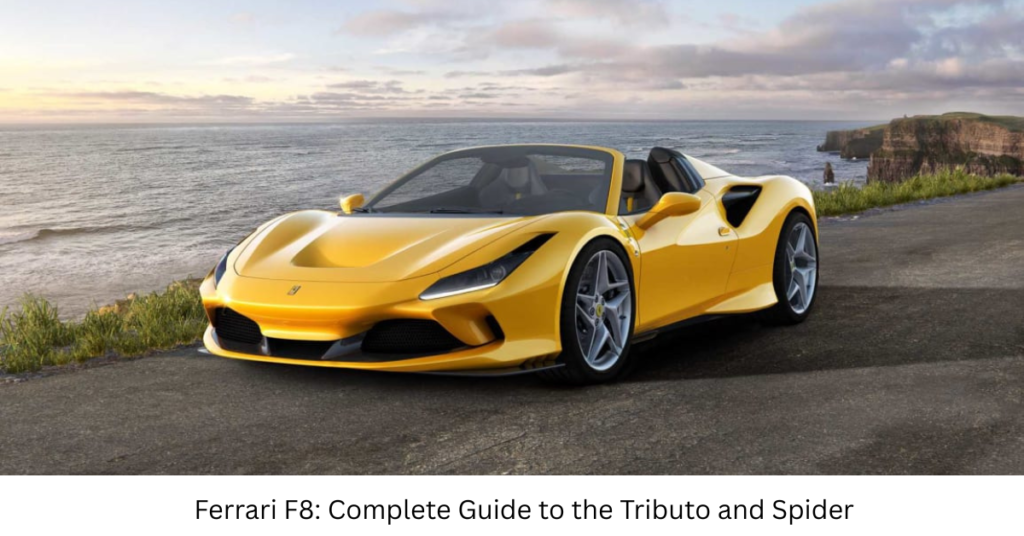
For drivers who want the same basic performance with an open cabin, the Ferrari F8 Spider is the obvious alternative.
Rather than using a conventional soft top, Ferrari fitted the Spider with a retractable hardtop. The roof can be opened or closed in around 14 seconds and can be operated while the car is moving at low speeds.
The Spider retains the same 3.9-liter V8 and 720 cv output. However, the additional roof mechanism and structural requirements increase its dry weight to approximately 1,400 kg. Ferrari quotes 0–100 km/h in 2.9 seconds, 0–200 km/h in 8.2 seconds, and a 340 km/h top speed.
That means the performance penalty compared with the coupe is relatively small. For many owners, the ability to drop the roof and hear the V8 more clearly is worth the trade-off.
White Ferrari F8 Spider Convertible Front View
A white Ferrari F8 Spider convertible front view highlights just how much of the car’s visual character comes from its aerodynamic front-end design.
White paint tends to emphasize the sculpted bonnet, sharp headlights, large lower intakes, and low nose. Add dark carbon-fiber accents and black wheels, and the Spider can take on a particularly dramatic appearance.
Ferrari F8 Specs at a Glance
Here are the key factory specifications for the two main versions:
| Specification | F8 Tributo | F8 Spider |
|---|---|---|
| Engine | 3.9L twin-turbo V8 | 3.9L twin-turbo V8 |
| Power | 720 cv | 720 cv |
| Torque | 770 Nm | 770 Nm |
| Transmission | 7-speed DCT | 7-speed DCT |
| Drive | Rear-wheel drive | Rear-wheel drive |
| 0–100 km/h | 2.9 sec | 2.9 sec |
| 0–200 km/h | 7.8 sec | 8.2 sec |
| Top speed | 340 km/h | 340 km/h |
| Dry weight | 1,330 kg* | 1,400 kg* |
*Ferrari’s published dry-weight figures depend on equipment and lightweight options.
These numbers explain why the F8 remains competitive with much newer supercars despite being based on a platform that has now left production.
Ferrari F8 Price: How Much Did It Cost New?
The original price depended heavily on the market, specification, taxes, and optional equipment.
For reference, Car and Driver listed a 2020 F8 range at approximately $274,280–$276,550 in the United States, with the Spider starting below the coupe in its published pricing.
Later model-year pricing varied. Car and Driver lists a starting MSRP of $283,950 for a 2023 F8 Tributo, although model-year availability was unusual because production was winding down.
So when researching the Ferrari F8 Tributo price, it’s important to distinguish between:
- Original MSRP
- Dealer asking price
- Used-market transaction value
- Highly optioned collector examples
A heavily personalized car with carbon-fiber options, desirable wheels, racing seats, special paint, and other factory extras can be worth considerably more than a lightly specified example.
Ferrari F8 for Sale: What Is the Used Market Like?
Because the F8 is no longer produced, shoppers looking for a Ferrari F8 for sale are generally dealing with used or previously registered vehicles.
That isn’t necessarily a disadvantage. In fact, it can give buyers access to specifications that would have required a lengthy factory ordering process when the car was new.
When searching for a used Ferrari F8, don’t focus solely on mileage. A better approach is to evaluate the entire car.
What to Check Before Buying
- Service history
Ask for complete maintenance documentation and verify that servicing has been carried out properly. - Accident history
A clean history is particularly important for a carbon-intensive supercar. - Ferrari maintenance records
Factory or specialist servicing can help establish how the vehicle has been treated. - Carbon-fiber condition
Inspect exposed carbon components carefully for damage or repairs. - Tires and brakes
Performance tires and brake components can be expensive consumables. - Paint and bodywork
Look for mismatched panels, paint corrections, stone chips, and evidence of previous repairs. - Optional equipment
Two cars with similar mileage can have very different values because of factory options. - Pre-purchase inspection
Have an experienced Ferrari technician inspect the car before completing a purchase.
If you’re comparing a Ferrari F8 Tributo for sale with a Spider, condition and specification should carry more weight than simply choosing the cheapest listing.
2020 Ferrari F8 Tributo: Why It Still Matters
The 2020 Ferrari F8 Tributo is especially interesting because it represents the early production version of the model.
It replaced the 488 GTB and brought the 720-cv version of Ferrari’s 3.9-liter V8 into a new generation of road cars. The F8 also inherited engineering lessons from the more extreme 488 Pista.
Car and Driver describes the F8 as an evolution of the 488, combining the Pista’s engine with mechanical, aerodynamic, and styling changes.
For buyers today, a 2020 example can make sense if it has excellent history, sensible mileage, and the right options. Age alone shouldn’t determine whether it’s a good purchase.
2022 Ferrari F8 Tributo and Spider
The 2022 Ferrari F8 Tributo sits in the later part of the model’s production life. Ferrari’s core mechanical recipe remained remarkably consistent: a 3.9-liter twin-turbo V8, rear-wheel drive, and a seven-speed dual-clutch gearbox.
The 2022 Ferrari F8 Spider offered the same fundamental performance in convertible form. This makes later examples appealing to buyers who want newer production years without moving into a completely different Ferrari platform.
One important point is that model-year listings can be confusing. Ferrari’s production and delivery schedules don’t always line up neatly with the model-year terminology used by automotive databases.
2023 Ferrari F8: A Rare Final Chapter
Searches for a 2023 Ferrari F8 need a little context.
Ferrari completed F8 family deliveries in 2023, but that doesn’t mean there was a normal, widely available 2023 coupe range. Car and Driver reported that only one 2023 F8 Tributo was imported to the Americas, while Ferrari subsequently confirmed that F8 Tributo and Spider deliveries concluded during 2023.
That makes a genuine late-production example potentially interesting from a collector’s perspective.
The 2023 Ferrari F8 Spider is similarly a late-production car rather than a new generation. Ferrari’s annual reporting confirms that the F8 Spider was phased out during the fourth quarter of 2023.
Ferrari F8 Spider Price and Resale Considerations
There isn’t one universal Ferrari F8 Spider price because used values depend heavily on mileage, condition, specification, location, and market conditions.
A low-mileage example with desirable options can command a significant premium over a higher-mileage car. Special colors and factory carbon-fiber packages can also influence buyer interest.
If you’re evaluating a Spider, compare several examples rather than judging the car from one listing. The best value isn’t necessarily the cheapest F8 available; it may be the car with the strongest history and most desirable specification.
Ferrari F8 Mansory: The Extreme Alternative
For owners who think the standard car isn’t dramatic enough, Mansory offers extensive aftermarket customization.
The Ferrari F8 Mansory concept is represented by the MANSORY F8XX, a complete conversion based on the F8 Tributo. Mansory lists forged-carbon body components, bespoke wheels, interior modifications, and substantial power increases among the changes.
Mansory states that its F8XX conversion can produce 880 hp and 960 Nm, with a claimed 0–100 km/h time of 2.6 seconds and a top speed of 354 km/h.
That’s an enormous increase over the factory specification, but it is worth remembering that this is a tuner conversion—not an official Ferrari factory variant.
Mansory also offers a softer customization package for the F8 Spider, including carbon-fiber additions, wheels, tires, and an optional performance upgrade.
What Makes the F8 Special?
Numbers only tell part of the story.
The F8 is special because it sits at an interesting point in Ferrari’s history. It represents one of the final generations of Ferrari’s pure, non-hybrid mid-engine V8 supercar formula before the company moved deeper into electrification.
Its character comes from several elements working together:
- Mid-rear-mounted V8
- Twin turbochargers
- Rear-wheel drive
- Extremely fast dual-clutch transmission
- Sophisticated electronic chassis control
- Aggressive but functional aerodynamics
- Two-seat layout
- Exceptional steering response
Ferrari also developed a performance kit featuring carbon-fiber wheels and Michelin Pilot Sport Cup 2 tires. Ferrari says the carbon wheels are substantially lighter than comparable forged or cast-aluminum wheels, reducing unsprung mass and improving responsiveness.
Is the F8 a Good Ferrari to Buy?
For someone shopping for a modern used Ferrari, the F8 makes a compelling case.
It’s fast enough to feel exotic, but the electronic systems make the performance more approachable than the raw numbers might suggest. At the same time, the car retains the emotional appeal of a traditional V8-powered Ferrari.
The main considerations are running costs, insurance, depreciation or appreciation potential, service history, and how the car has been driven.
If you’re buying one primarily as an investment, there are no guarantees. If you’re buying it because you genuinely enjoy driving and owning exceptional cars, the F8’s appeal is much easier to understand.
Ferrari F8 vs F8 Spider: Which One Should You Choose?
The decision is surprisingly straightforward.
Choose the Tributo if:
- You prefer a fixed-roof supercar.
- Maximum lightweight performance matters.
- You prefer the classic berlinetta shape.
- You’re interested in collector appeal.
- You don’t need open-top driving.
Choose the Spider if:
- You regularly drive in good weather.
- You love convertible cars.
- Engine sound is a major part of the experience.
- You want a supercar that feels special at lower speeds as well.
- The small weight increase doesn’t bother you.
Neither is objectively better. They’re designed for slightly different personalities.
Frequently Asked Questions
Is the Ferrari F8 a V8?
Yes. It uses a 3.9-liter twin-turbocharged V8. Ferrari’s official specification gives the engine 720 cv and 770 Nm.
How fast is the F8?
The factory-rated top speed is 340 km/h. The Tributo reaches 100 km/h in 2.9 seconds and 200 km/h in 7.8 seconds, while the Spider reaches 200 km/h in 8.2 seconds.
What is the Ferrari F8 price?
Original U.S. MSRP varied by year and body style. For example, Car and Driver listed the 2020 range at roughly $274,280–$276,550. Used-market prices can vary substantially depending on specification and condition.
Is the F8 discontinued?
Yes. Ferrari completed F8 Tributo and F8 Spider deliveries in 2023, with the coupe and Spider phased out during the year.
Is there a 2023 F8 Tributo?
There were extremely limited 2023-model-year examples. Car and Driver reported that Ferrari North America imported just one 2023 F8 Tributo to its market.
Is the F8 Spider faster than the Tributo?
Not in absolute top speed. Both are rated at 340 km/h, while the Spider takes slightly longer to reach 200 km/h because of its additional weight.
What is the difference between the F8 Tributo and Spider?
The most obvious difference is the roof. The Tributo has a fixed roof, while the Spider uses a retractable hardtop. The Spider is heavier, but it retains the same 720-cv engine and 340 km/h claimed top speed.
Is a Ferrari F8 good for daily driving?
It can be, provided the owner accepts the running costs and practical compromises of a mid-engine supercar. The cabin is more usable than the extreme performance figures might suggest, but maintenance, tires, fuel, parking, and ground clearance still require consideration.
Is the MANSORY F8 an official Ferrari?
No. The MANSORY F8XX is a MANSORY conversion based on the Ferrari F8 Tributo. It uses aftermarket body, interior, wheel, and performance modifications rather than being a factory Ferrari model.
Final Verdict
The Ferrari F8 is more than simply another fast Ferrari. It represents the end of an important chapter: a lightweight, rear-wheel-drive, twin-turbo V8 mid-engine supercar built before Ferrari’s lineup moved further toward hybrid powertrains.
The F8 Tributo is the choice for traditional supercar enthusiasts, while the F8 Spider adds the freedom of open-air driving without sacrificing the essential performance formula. With production now finished, well-maintained examples are increasingly being judged not only as performance cars but also as important modern Ferraris.
If you’re considering buying one, focus on condition, service history, specification, and provenance rather than chasing the lowest advertised price. And if you’re simply an enthusiast, the F8 is worth studying closely—it may ultimately be remembered as one of the defining Ferrari V8s of its era.