
Ferrari spent decades building cars that were meant to be driven hard, admired from a distance, and occasionally parked somewhere with a very nervous owner nearby. Then came the Ferrari Purosangue—a car with four doors, four proper seats and enough practicality to make it usable every day.
But calling it simply an SUV doesn’t quite tell the story. Ferrari itself describes the Purosangue as its first four-door, four-seater car, and the formula is radically different from the typical performance SUV. Under the hood sits a naturally aspirated 6.5-liter V12, while sophisticated suspension and all-wheel-drive technology are designed to preserve the sharp driving character associated with Ferrari.
So, what exactly makes this car so unusual? Let’s take a closer look at its engine, performance, interior, pricing, styling, practicality and the questions buyers commonly ask.
What Is the Ferrari Purosangue?
The name “Purosangue” translates roughly to “thoroughbred” in Italian, which is a pretty fitting name for Ferrari’s first four-door, four-seat production car.
Although its raised stance and large body make it resemble a luxury crossover, Ferrari has been careful about positioning it differently from conventional SUVs. The company’s approach was to build a Ferrari first and give it greater versatility rather than create a traditional SUV with a Ferrari badge.
That distinction becomes obvious when you look at the hardware.
The car uses a front-mid-mounted V12, an eight-speed dual-clutch transmission and Ferrari’s sophisticated 4RM-S all-wheel-drive system. Ferrari also developed an active suspension system specifically for the Purosangue to control body movement without sacrificing handling.
In other words, this is not simply a family car with a huge engine.
Ferrari Purosangue Engine and Power
The heart of the car is one of its biggest talking points.
The Ferrari Purosangue engine is a naturally aspirated 6.5-liter V12, internally identified as F140IA. It uses a 65-degree cylinder-bank angle, dry-sump lubrication and direct fuel injection. Ferrari rates it at 725 cv at 7,750 rpm, with maximum torque of 716 Nm at 6,250 rpm.
The engine can rev to 8,250 rpm, which helps explain why the Purosangue feels so different from many modern high-performance SUVs that rely on turbocharged V8 engines or hybrid powertrains.
Ferrari Purosangue Specs at a Glance
| Specification | Ferrari Purosangue |
|---|---|
| Engine | 6.5-liter naturally aspirated V12 |
| Power | 725 cv |
| Torque | 716 Nm |
| Transmission | 8-speed dual-clutch |
| Drivetrain | 4RM-S all-wheel drive |
| 0–100 km/h | 3.3 seconds |
| 0–200 km/h | 10.6 seconds |
| Top speed | Over 310 km/h |
| Fuel tank | 100 liters |
| Boot capacity | 473 liters |
| Dry weight | 2,033 kg* |
*Ferrari’s quoted dry weight includes optional lightweight content.
Those numbers put the car firmly in supercar territory, despite its four-door configuration.
Ferrari Purosangue 0-60 Performance
If you’re wondering about the Ferrari Purosangue 0-60, Ferrari officially quotes 0–100 km/h in 3.3 seconds rather than a 0–60 mph figure.
That means it reaches 100 km/h in roughly the same time many exotic sports cars needed not that long ago.
Ferrari also claims 0–200 km/h in 10.6 seconds, while maximum speed is above 310 km/h.
The impressive part isn’t just the acceleration. The Purosangue combines that pace with four-wheel drive, sophisticated electronic controls and active suspension designed to keep the car composed when the road gets interesting.
Ferrari Purosangue Interior: Four Seats, Not a Token Back Row
The Ferrari Purosangue interior is one of the areas where Ferrari took a different approach.
Rather than installing tiny rear seats that adults would tolerate for ten minutes, Ferrari designed the car as a genuine four-seater. All four seats are electrically adjustable and heated, while the rear seats are designed to accommodate adults.
The rear doors are also rear-hinged. Ferrari calls these “welcome doors,” and the arrangement makes getting into the back considerably easier.
What Makes the Cabin Different?
The interior focuses on keeping the driver connected to the car while giving passengers considerably more space than a traditional Ferrari sports car.
Key features include:
- Four individual seats
- Heated electric seats
- Rear-hinged rear doors
- Premium leather and upholstery options
- High-end audio equipment
- A separate driver-focused cockpit layout
- Foldable rear seats
- A useful rear luggage area
Ferrari states that the Purosangue has the largest boot it has ever offered, with 473 liters of luggage capacity and additional space available when the rear seats are folded.
That makes it far more usable for road trips than a conventional two-seat Ferrari.
Ferrari Purosangue SUV or Something Else?
Searches for Ferrari Purosangue SUV are understandable because the car looks SUV-like from certain angles.
However, Ferrari has consistently emphasized that the Purosangue is a sports car rather than a conventional SUV. Its proportions, low seating position, suspension technology and powertrain were all developed around that philosophy.
The distinction isn’t just marketing.
A typical luxury performance SUV prioritizes a combination of high ground clearance, cargo space, passenger room and performance. The Purosangue places much greater emphasis on driving dynamics.
It is better thought of as a four-door Ferrari with crossover practicality.
That makes comparisons with cars such as the Lamborghini Urus, Aston Martin DBX and Bentley Bentayga inevitable, but the Ferrari takes a noticeably different route.
Ferrari Purosangue Price: How Much Does It Cost?
The Ferrari Purosangue price varies by market and can rise significantly once options, taxes and customization are included.
For the 2026 model year, Car and Driver lists a U.S. starting MSRP of $432,986.
That’s before getting carried away with Ferrari’s extensive personalization options.
And that matters because Ferrari buyers rarely stop at the base configuration. Special paint, wheels, interior materials, carbon-fiber components and other options can push the final transaction price considerably higher.
Ferrari Purosangue 2026 Price
If you’re specifically searching for the Ferrari Purosangue 2026 price, approximately $433,000 is a useful U.S. starting-point figure based on current published pricing.
Actual prices can differ by country because of taxes, registration charges, import duties and dealer-specific factors.
For buyers outside the United States, particularly in markets with substantial luxury-car taxation, the final price can be dramatically higher.
Ferrari Purosangue for Sale: New vs Used
Finding a Ferrari Purosangue for sale isn’t quite like shopping for a normal luxury SUV.
Ferrari production is deliberately limited, and demand for the car has been strong. Buyers may therefore encounter new allocations, nearly new examples and used cars with very different specifications and asking prices.
When shopping for one, don’t focus only on mileage.
Pay attention to:
- Specification and options – Two visually similar cars can have very different original prices.
- Service history – Ferrari maintenance documentation matters considerably.
- Warranty coverage – Check exactly what remains.
- Paint and interior condition – Expensive finishes can make repairs costly.
- Wheel and tire condition – Large performance tires aren’t cheap.
- Vehicle history – Verify accidents, ownership and servicing.
- Market value – Compare multiple examples rather than accepting the first asking price.
For a car at this price level, a professional inspection and thorough history check are sensible steps.
2024 Ferrari Purosangue and 2025 Ferrari Purosangue
The 2024 Ferrari Purosangue and 2025 Ferrari Purosangue belong to the same generation and share the fundamental formula: naturally aspirated V12 power, four seats, four doors, all-wheel drive and Ferrari’s active suspension technology.
The same basic philosophy continues into the 2026 Ferrari Purosangue.
That means someone shopping across model years should pay close attention to equipment, specification, condition and pricing rather than assuming a newer model automatically represents a major mechanical redesign.
As with many Ferrari models, customization can make one example substantially different from another.
Ferrari Purosangue Colors: Red, Black and Beyond
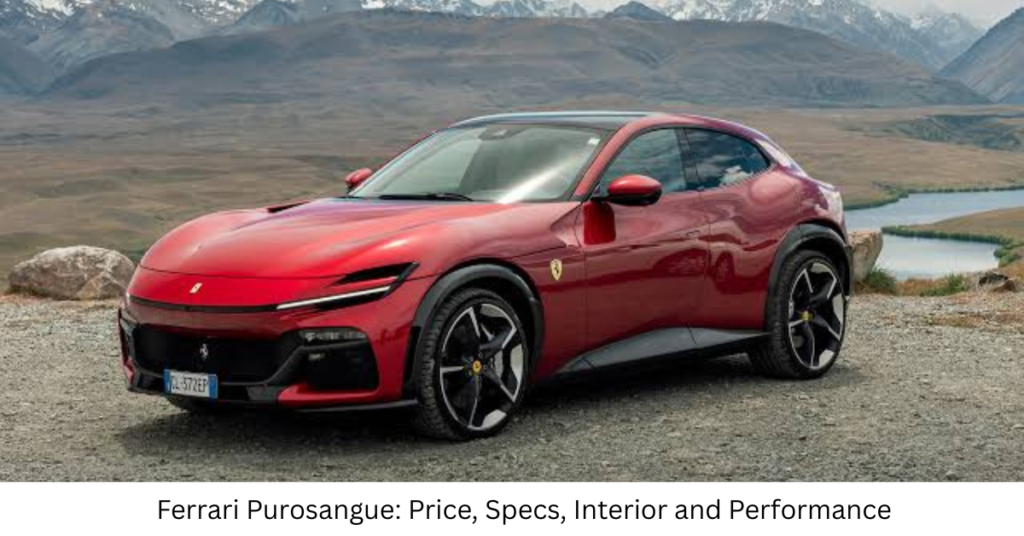
A red Ferrari Purosangue is probably the image most people picture when they hear the word Ferrari.
Ferrari’s traditional reds remain highly recognizable, but the car looks dramatically different depending on its specification. Ferrari has also showcased the Purosangue in colors including Grigio Titanio and Nero Purosangue.
Ferrari Purosangue Red
Ferrari red works particularly well with the Purosangue’s long hood, muscular rear quarters and aggressive front-end design.
It’s the classic choice—but not necessarily the most subtle.
Ferrari Purosangue Black
The Ferrari Purosangue black look takes the car in a completely different direction. Dark paint emphasizes the aggressive proportions and can make the body appear visually lower.
For buyers who want something understated, black with a dark interior and matching wheels can create a much more discreet appearance.
Ferrari Purosangue Mansory: What Is It?
The Ferrari Purosangue Mansory topic has generated plenty of interest among people looking for an even more customized version of the car.
Mansory is known for aftermarket customization, including aggressive bodywork, wheels, interiors and performance modifications. A Mansory-modified Purosangue can therefore look substantially more dramatic than a factory example.
However, it’s important to distinguish a Mansory Ferrari Purosangue from an official Ferrari factory model.
Mansory modifications are aftermarket creations, not a separate Ferrari production variant. Anyone considering such a car should carefully investigate the exact modifications, who performed them, warranty implications and the vehicle’s service history.
For many owners, the standard Ferrari design is already distinctive enough.
What About the “Ferrari Purosangue Leaked” Stories?
Before the production car was officially unveiled, years of speculation surrounded Ferrari’s first high-riding model.
That naturally led to searches for Ferrari Purosangue leaked images, renders and alleged specifications.
It’s worth being careful with early leaks. Automotive prototypes can look dramatically different from production vehicles, while unofficial renders may be based on speculation rather than genuine Ferrari material.
The production car was officially unveiled by Ferrari in September 2022. Ferrari confirmed its four-door, four-seat layout and naturally aspirated V12 at the time.
So, when researching older leak stories, official Ferrari specifications are a much better reference point than social-media renders or anonymous claims.
Driving Experience: Why the Purosangue Feels Like a Ferrari
This is arguably the most important part.
The Purosangue isn’t impressive merely because it is fast. Ferrari engineered it to preserve the kind of immediate steering response and body control that enthusiasts expect from the brand.
Its Ferrari Active Suspension Technology helps manage body roll and tire contact, while the 4RM-S system and electronic controls help distribute traction.
The result is a car that can be comfortable when you’re simply cruising but becomes seriously engaging when the road opens up.
And then there’s the V12.
In an automotive world increasingly dominated by turbocharging, electrification and downsized engines, a naturally aspirated 6.5-liter V12 screaming toward 8,250 rpm feels increasingly special.
Is the Purosangue Practical?
Surprisingly, yes—but with an important qualification.
It is practical for a Ferrari.
You get four usable seats, four doors and a decent luggage compartment. Ferrari also designed the rear seats to fold, providing additional cargo flexibility.
But if maximum cargo capacity or everyday utility is your priority, plenty of conventional SUVs will make more sense.
The Purosangue exists for someone who wants practicality without giving up the experience of driving an exotic Ferrari.
That’s a very different proposition.
Pros and Cons
Pros
- Naturally aspirated V12
- 725 cv of power
- Four genuinely usable seats
- Four doors
- Excellent acceleration
- Over 310 km/h top speed
- Advanced active suspension
- Distinctive Ferrari design
- More practical than traditional Ferrari sports cars
Cons
- Extremely expensive
- Running costs are likely to be substantial
- Fuel consumption is high
- Not as spacious as a conventional luxury SUV
- Expensive options can quickly increase the purchase price
- Its SUV-like appearance may disappoint buyers expecting traditional SUV practicality
Ferrari quotes combined WLTP fuel consumption of 17.3 L/100 km and CO₂ emissions of 393 g/km, illustrating just how thirsty the V12 can be.
Ferrari Purosangue vs Traditional Performance SUVs
The Purosangue occupies an unusual position.
Cars such as the Lamborghini Urus and Aston Martin DBX are designed much more explicitly as SUVs. The Ferrari instead tries to deliver the driving experience of a high-performance sports car while adding four-seat practicality.
That difference explains much of its appeal.
If you want the most practical vehicle possible, the Ferrari isn’t the obvious choice. If you want an exotic car that can take three passengers and luggage without feeling like a compromise, the equation changes dramatically.
Frequently Asked Questions
Is the Ferrari Purosangue an SUV?
It has SUV-like proportions and a raised body, but Ferrari positions it as a four-door, four-seat sports car rather than a conventional SUV.
How much does a Ferrari Purosangue cost?
For 2026, published U.S. pricing puts the starting MSRP at about $432,986, before options and other market-specific costs.
What engine does the Purosangue have?
It uses a naturally aspirated 6.5-liter V12 producing 725 cv and 716 Nm of torque.
How fast is the Ferrari Purosangue?
Ferrari quotes 0–100 km/h in 3.3 seconds, 0–200 km/h in 10.6 seconds and a top speed exceeding 310 km/h.
Does the Ferrari Purosangue have four seats?
Yes. It is Ferrari’s first four-door, four-seat production car, with four individual electric seats.
Is there a Ferrari Purosangue 2026 model?
Yes. The Purosangue continues into the 2026 model year, with current U.S. pricing listed at approximately $433,000 before options.
Is there a Mansory Purosangue?
Mansory has become associated with customized versions of high-end performance cars, including the Purosangue. These should be distinguished from official Ferrari factory models.
What does Purosangue mean?
“Purosangue” is Italian for “thoroughbred” or “purebred,” reflecting Ferrari’s intention to emphasize the car’s connection to its sports-car heritage.
Conclusion
The Ferrari Purosangue is difficult to categorize—and that’s exactly what makes it interesting.
It combines a naturally aspirated V12, supercar-level acceleration, advanced chassis technology and Ferrari’s unmistakable styling with something the company had never previously offered in this format: four doors and four proper seats.
The price is enormous, the fuel consumption isn’t exactly economical, and it isn’t the most practical SUV money can buy. But that’s not really the point.
The Purosangue is aimed at buyers who want the drama and emotion of a Ferrari without leaving their family, friends or luggage behind.
And in a market increasingly filled with turbocharged and electrified performance SUVs, the sound and character of that high-revving V12 may ultimately be one of the car’s biggest attractions.
If you’re researching a Ferrari Purosangue for sale, comparing model years, or simply fascinated by Ferrari’s unusual approach to the luxury performance market, its combination of practicality and old-school V12 character makes it one of the most interesting modern Ferraris to explore.