
A small cavity can start as a minor annoyance, but ignoring it can eventually turn into a much more expensive dental problem. If you’re wondering about the pasta teeth price in Philippines, the good news is that tooth filling is generally one of the more affordable ways to treat tooth decay.
In the Philippines, the cost of dental filling can vary considerably depending on the material, size and location of the cavity, type of tooth, and dental clinic. Current published price guides and clinic schedules show that a basic filling may cost around ₱500 to ₱4,500 or more per tooth or surface, while government or public dental facilities may offer lower rates.
Here’s what you should know before booking an appointment.
What Is Pasta sa Ngipin?
“Pasta sa ngipin” is the common Filipino term for a dental filling or tooth restoration. It involves removing decayed or damaged portions of a tooth and filling the resulting space with a dental material.
The goal isn’t simply to cover the hole. A properly placed filling helps restore the tooth’s shape and chewing function while preventing decay from progressing further.
Depending on the condition of the tooth, a dentist may recommend composite resin, amalgam, glass ionomer, or another restorative material.
How Much Does Pasta Teeth Cost in the Philippines?
There isn’t one fixed national price. Based on current published Philippine dental prices, you can generally expect the following ranges:
| Type of filling | Typical price range |
|---|---|
| Amalgam/silver filling | ₱600–₱2,800 |
| Composite resin filling | ₱1,000–₱4,500 |
| Glass ionomer filling | ₱800–₱3,800 |
| Ceramic inlay/onlay | ₱3,000–₱15,000+ |
| Basic government/public restoration | Around ₱750–₱1,000 in some facilities |
These are indicative figures rather than a universal price list. For example, one Philippine government hospital’s published schedule lists tooth restoration at ₱750 for a small cavity and ₱1,000 for a large or deep cavity, while a Quezon City dental clinic advertises restoration starting at ₱500, with higher prices depending on the tooth and surface.
Private clinics in major cities can charge substantially more, particularly for cosmetic composite restorations.
Dental Filling Prices by Material
Composite Resin Filling
Composite resin is one of the most popular choices because it can be matched closely to the natural color of your teeth.
Current Philippine price guides put composite fillings roughly in the ₱1,000–₱4,500 range, although the actual amount depends heavily on the clinic and the size of the restoration.
Advantages include:
- Natural-looking appearance
- Suitable for front and back teeth
- Bonds directly to tooth structure
- Good option when appearance matters
The trade-off is that composite generally costs more than basic amalgam.
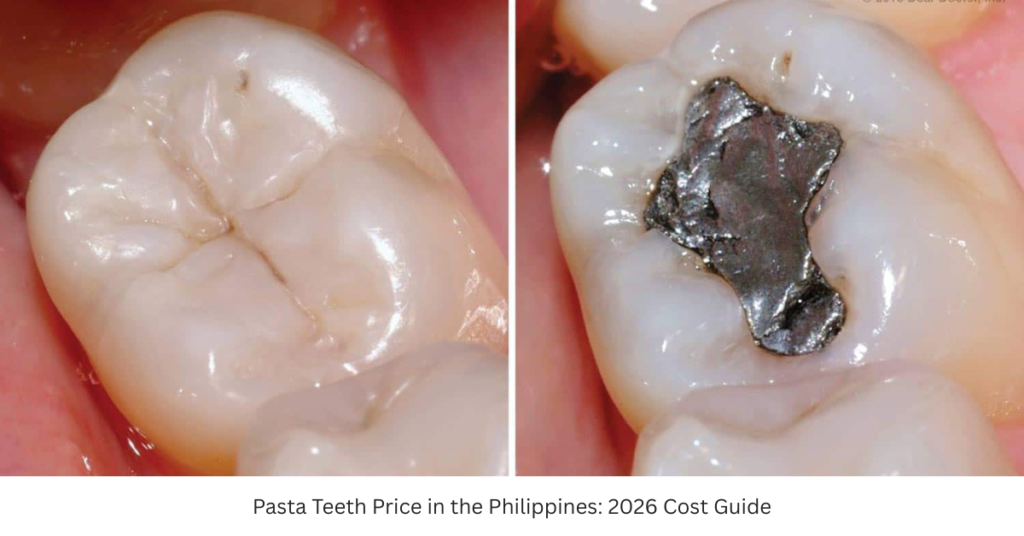
Amalgam or Silver Filling
Amalgam has traditionally been one of the more economical filling materials. It is particularly associated with molars because it can withstand considerable chewing pressure.
Published estimates place amalgam fillings at roughly ₱600–₱2,800, depending on the clinic and complexity.
Its main drawback is appearance: unlike composite resin, it has a noticeable silver-gray color.
Glass Ionomer Filling
Glass ionomer cement, commonly called GIC, is another restorative option. It can be useful for particular cavities, including some areas close to the gum line, and is also used in certain pediatric dental treatments.
Prices vary, but current estimates generally fall around ₱800–₱3,800.
Your dentist will determine whether it is appropriate based on the location and condition of the tooth.
Ceramic Inlays and Onlays
If a cavity is too extensive for a straightforward filling but doesn’t necessarily require a full crown, a dentist may recommend an inlay or onlay.
These restorations are more expensive because they are custom-made and typically require more complex treatment. Published Philippine estimates range from several thousand pesos into the five-figure range depending on the material and clinic.
They aren’t usually necessary for a small cavity.
What Factors Affect the Cost?
Two people can visit different dentists with what appears to be the same problem and receive very different quotes. That’s because several factors influence dental treatment costs.
1. Size of the Cavity
A small cavity affecting one surface is usually cheaper than a deep cavity involving multiple surfaces.
Some clinics price fillings according to the number of surfaces being restored, so a larger restoration naturally costs more. One Quezon City clinic, for example, lists different prices for anterior and posterior restorations on a per-surface basis.
2. Location of the Tooth
Front teeth often require greater attention to shape, shade, and appearance. Back teeth, particularly molars, may require more extensive restoration because they have multiple surfaces and handle significant chewing forces.
As a result, the tooth being treated can affect the final quotation.
3. Filling Material
Material is another major factor.
A basic amalgam restoration is usually less expensive than a high-quality aesthetic composite, while ceramic restorations can cost considerably more.
4. Dental Clinic Location
Dental prices aren’t identical throughout the country. Clinics in premium commercial areas and major metropolitan locations may have higher operating costs than smaller practices or public facilities.
5. Dentist’s Experience and Clinic Facilities
A clinic with modern equipment, advanced diagnostic technology, and a dentist specializing in cosmetic or restorative dentistry may charge more.
That doesn’t automatically mean a cheaper clinic provides poor treatment. It’s simply important to consider qualifications, sterilization standards, materials, and the quality of care rather than choosing based on price alone.
Are There Extra Costs Besides the Filling?
Sometimes, yes.
Before treatment, the dentist may need to perform an examination or take an X-ray to determine how deep the decay is. If the cavity is close to the nerve, additional treatment may also be required.
Possible additional expenses include:
- Dental consultation
- Dental X-ray
- Local anesthesia
- Deep cavity liner or base
- Temporary restoration
- Root canal treatment
- Dental crown
This is why asking for the total estimated cost before starting treatment is a good idea.
If the decay has reached the pulp, a simple filling may no longer be enough. In that situation, root canal treatment followed by appropriate restoration may be necessary.
Pasta Price for Front Teeth vs. Back Teeth
The cost can also vary according to which tooth needs treatment.
Front Teeth
Front teeth are highly visible, so patients commonly choose tooth-colored composite resin. The dentist also has to pay close attention to the shade, shape, and contours of the restoration.
This can make an aesthetic restoration more expensive than a basic filling.
Back Teeth
Molars and premolars have larger chewing surfaces and may have cavities affecting several areas of the tooth. This can increase both the amount of material and the time needed for treatment.
Some Philippine price listings show posterior composite restorations priced lower per surface than anterior restorations, although actual prices vary between clinics.
How to Save Money on Dental Fillings
If you’re trying to keep dental expenses manageable, there are several sensible approaches.
1. Treat Cavities Early
This is probably the most important one.
A small cavity may require a straightforward restoration. If decay progresses into the pulp, treatment can become significantly more complicated and expensive.
2. Compare Several Clinics
Don’t be afraid to contact two or three dental clinics and ask about their current rates.
Ask specifically:
- How much is a basic filling?
- Is the price per tooth or per surface?
- Is consultation included?
- Is X-ray included?
- Is anesthesia included?
- What filling material is used?
- Will there be additional charges?
3. Check Public Dental Services
Government hospitals and public dental facilities may offer substantially lower rates. For example, the Ospital ng Palawan’s published schedule lists restoration at ₱750 for small cavities and ₱1,000 for large or deep cavities.
Availability, waiting times, eligibility, and materials can vary, so check with the facility before visiting.
4. Ask About Your HMO or Dental Coverage
If you have an HMO or dental insurance plan, check whether fillings are covered and whether there are restrictions on particular materials or participating dentists.
Is Cheap Pasta Always Better?
Not necessarily.
The cheapest option isn’t automatically the best, but the most expensive option isn’t automatically necessary either. The right treatment depends on the condition of your tooth, the location of the cavity, your budget, and the dentist’s professional assessment.
For a small cavity on a visible front tooth, for example, tooth-colored composite may make more sense than an inexpensive metallic restoration. For a larger back-tooth restoration, your dentist may recommend a different material based on strength and longevity.
The key is to ask why a particular material is being recommended rather than choosing solely according to price.
What Happens During a Dental Filling?
If you’ve never had a filling before, the procedure is usually straightforward.
- Examination: The dentist checks the tooth and determines how extensive the decay is.
- Numbing: Local anesthesia may be used to make the procedure comfortable.
- Decay removal: The damaged portion of the tooth is carefully removed.
- Cleaning: The area is cleaned and prepared for the filling.
- Filling placement: The selected material is placed into the cavity.
- Shaping: The dentist shapes the restoration so it fits naturally with your bite.
- Final check: Your bite is checked and adjustments are made if necessary.
The exact process varies according to the material and condition of the tooth.
Does Getting a Filling Hurt?
With modern local anesthesia, most people should experience little or no significant pain during the procedure.
You may experience some sensitivity or mild discomfort afterward, particularly if the cavity was deep. If pain persists, becomes severe, or worsens rather than improving, contact your dentist for an assessment.
How Long Does a Dental Filling Last?
There isn’t a guaranteed lifespan for every filling. Durability depends on the material, size of the restoration, tooth location, biting forces, oral hygiene, and whether new decay develops around the filling.
Some published Philippine dental guides estimate composite fillings at around 5–10 years and amalgam at approximately 10–15 years, although individual results can vary considerably.
Regular dental checkups can help identify worn or damaged restorations before they become a bigger problem.
FAQs About Pasta Teeth Price in the Philippines
How much is pasta sa ngipin in the Philippines?
A basic tooth restoration can start at around ₱500–₱1,000 in some clinics or public facilities, while private composite restorations can cost ₱1,500–₱4,500 or more depending on the tooth, material, and number of surfaces.
How much does a composite filling cost?
Composite fillings commonly cost around ₱1,000–₱4,500, although individual clinics may charge outside this range. The size and location of the restoration are important factors.
Is pasta sa ngipin the same as a dental filling?
Yes. “Pasta sa ngipin” is a commonly used Filipino expression for restoring a tooth with a filling. In English, the procedure is generally called a dental filling or tooth restoration.
Is filling cheaper than root canal treatment?
Usually, yes. A simple filling is less extensive than root canal treatment. However, they are not interchangeable treatments. If decay has reached the tooth’s pulp, a filling alone may not solve the problem.
Can I get a cheap dental filling at a government clinic?
Yes, some government hospitals and public dental facilities offer lower-cost restorative treatment. Published schedules can be considerably cheaper than private-clinic rates, although availability and waiting times vary.
How do I know which filling material I need?
Your dentist should assess the cavity’s size, depth, location, and condition before recommending a material. Don’t choose solely based on the lowest price.
Final Thoughts
The pasta teeth price in Philippines can range from a few hundred pesos for basic restoration to several thousand pesos for premium composite or ceramic work. A realistic budget for many routine fillings is around ₱800–₱4,500, but your actual quotation depends on the material, cavity size, tooth location, and clinic.
If you have a visible hole, tooth sensitivity, or recurring pain, don’t wait for the problem to become worse just to save money. Have the tooth examined, ask for a clear treatment estimate, and compare reputable clinics if necessary. Early treatment is often the simplest way to protect both your teeth and your budget.
Prices mentioned in this guide are indicative and can change by clinic, city, material, and treatment complexity. Always confirm the current price directly with the dental clinic before treatment.