
A Ferrari with a turbocharged V8 is hardly surprising. A Ferrari with 1,000 cv, three electric motors, all-wheel drive, and plug-in hybrid technology is a very different story.
The Ferrari SF90 represents one of the biggest technological shifts in Ferrari’s modern history. Introduced as the marque’s first series-production plug-in hybrid, the SF90 Stradale combines a 4.0-liter twin-turbo V8 with three electric motors to produce a remarkable 1,000 cv. Ferrari later expanded the family with the open-top SF90 Spider and the much more track-focused SF90 XX Stradale.
What makes the SF90 particularly interesting isn’t simply its headline horsepower. It is the way Ferrari uses electrification to improve acceleration, traction, handling and everyday drivability while retaining the character of a mid-engine Italian supercar.
What Is the Ferrari SF90?
The SF90 Stradale was unveiled in 2019 as Ferrari’s first plug-in hybrid electric vehicle. Its name also pays tribute to the 90th anniversary of Scuderia Ferrari, the company’s racing division.
Unlike a conventional hybrid designed primarily around fuel economy, the SF90 uses electric power as a performance tool. Two electric motors drive the front wheels, while a third sits at the rear between the engine and eight-speed dual-clutch transmission.
The result is an all-wheel-drive supercar capable of producing 1,000 cv and accelerating from 0 to 100 km/h in just 2.5 seconds. Ferrari quotes a top speed of more than 340 km/h for the original Stradale.
Ferrari SF90 Stradale Powertrain and Performance
At the heart of the car is a 3,990 cc, 90-degree twin-turbocharged V8. The combustion engine alone produces 780 cv, while the electric motors contribute the remaining output needed to reach the system’s 1,000-cv peak.
The numbers are impressive:
- Engine: 3.99-liter twin-turbo V8
- V8 output: 780 cv
- Combined output: 1,000 cv
- Electric motors: Three
- Transmission: Eight-speed dual-clutch
- Drive system: All-wheel drive
- 0–100 km/h: 2.5 seconds
- 0–200 km/h: 7.0 seconds
- Top speed: Over 340 km/h
- Electric-only range: Up to approximately 25 km
Ferrari’s engineering approach is particularly clever. The two front electric motors can independently control the front wheels, giving the car an unusually sophisticated form of torque management. The third motor works at the rear alongside the V8.
Why the Hybrid System Matters
It would be easy to look at the hybrid system as simply a way to increase horsepower. That misses the bigger picture.
Electric motors deliver torque almost instantly. In the SF90, that immediate response helps fill gaps in the V8’s power delivery while also improving traction when accelerating out of corners.
The car can also operate in electric-only mode. Ferrari states that the SF90 can travel up to around 25 km without using the V8, making it possible to drive quietly in situations where a traditional Ferrari would be less practical.
Ferrari SF90 Interior: Technology Meets Minimalism
The Ferrari SF90 interior takes a noticeably different approach from older Ferrari cabins.
The cockpit is designed around the driver, with a strong emphasis on digital displays and controls. Ferrari introduced a large digital instrument cluster while retaining physical controls for important functions.
One of the most recognizable features is the steering wheel and its integrated controls. Rather than forcing the driver to constantly reach toward the center console, Ferrari places many frequently used functions within easy reach.
The interior also reflects the car’s dual personality. It can feel futuristic and technologically advanced during normal driving, yet the driver is always reminded that the car was engineered around performance.
Available materials include leather, Alcantara and carbon-fiber trim, depending on specification. As with most Ferraris, buyers can personalize the cabin extensively.
Ferrari SF90 Spider: Supercar With an Open Roof
For people who want the same basic performance with an entirely different atmosphere, Ferrari introduced the SF90 Spider in 2020.
It uses the same fundamental plug-in hybrid architecture as the Stradale, including the 4.0-liter V8 and three electric motors. Combined output remains 1,000 cv.
Performance is still staggering:
- 0–100 km/h: 2.5 seconds
- 0–200 km/h: 7.0 seconds
- Top speed: 340 km/h
- Combined output: 1,000 cv
The biggest difference is the retractable hardtop. Ferrari’s roof system can transform the character of the car without turning it into a compromise-focused convertible.
Ferrari SF90 Spider vs Stradale
The choice largely comes down to priorities.
Choose the Stradale if:
- You prefer a fixed-roof supercar.
- Maximum focus is placed on performance.
- You prefer the more traditional berlinetta silhouette.
- You want a slightly more focused driving experience.
Choose the Spider if:
- You want open-air driving.
- You value the theater of hearing the V8 with the roof down.
- You want similar headline performance with greater versatility.
- The retractable hardtop is part of the appeal.
The Spider does carry additional weight compared with the fixed-roof car, but Ferrari engineered it to retain essentially the same performance credentials.
Ferrari SF90 XX Stradale: Taking Things to Another Level
Then Ferrari decided that 1,000 cv wasn’t enough.
The SF90 XX Stradale takes the standard car’s formula and pushes it much further toward track driving. It produces 1,030 cv, 30 cv more than the regular SF90, while receiving substantial aerodynamic and software changes.
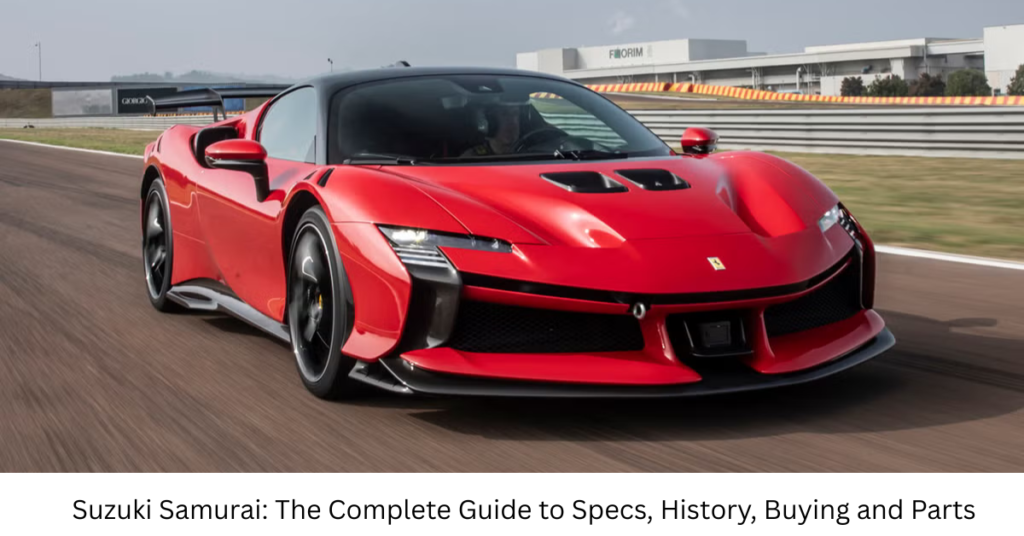
The most obvious visual difference is the fixed rear wing. It isn’t merely there for appearance: Ferrari says the aerodynamic package can generate as much as 530 kg of downforce at 250 km/h.
The XX Stradale is also quicker:
- Power: 1,030 cv
- 0–100 km/h: 2.3 seconds
- 0–200 km/h: 6.5 seconds
- Top speed: 320 km/h
- Dry weight: approximately 1,560 kg with optional content
Ferrari describes the XX Stradale as its first road-legal car inspired directly by the company’s exclusive XX Programme. That distinction matters: traditional XX cars were developed primarily for track use and were not road homologated.
Ferrari SF90 XX vs SF90 Stradale
The two cars share the same basic DNA, but their personalities are quite different.
| Feature | SF90 Stradale | SF90 XX Stradale |
|---|---|---|
| Power | 1,000 cv | 1,030 cv |
| 0–100 km/h | 2.5 sec | 2.3 sec |
| 0–200 km/h | 7.0 sec | 6.5 sec |
| Engine | 4.0L twin-turbo V8 | 4.0L twin-turbo V8 |
| Electric motors | 3 | 3 |
| Top speed | 340+ km/h | 320 km/h |
| Character | Road-focused supercar | Track-focused road car |
Interestingly, the XX has a lower quoted top speed despite being faster in acceleration. That’s not an accident. Its engineering priorities are heavily focused on cornering performance, aerodynamic grip and lap times rather than simply chasing the highest possible speed.
Ferrari has also developed an SF90 XX Spider, combining the XX specification with open-top driving. Its roof can retract in around 14 seconds and can be operated at speeds of up to 45 km/h.
Ferrari SF90 Price: How Much Does It Cost?
The Ferrari SF90 price depends heavily on market, model year, specification, options and whether you’re looking at a new or used example.
Ferrari does not maintain one universal worldwide retail price because pricing varies between countries and markets. Optional equipment can also add a significant amount to the final invoice.
For someone shopping for one today, there are several factors worth considering:
- Original MSRP or market launch price
- Model year
- Mileage
- Service history
- Carbon-fiber and performance options
- Exterior and interior specification
- Warranty coverage
- Market demand
- Limited-production status
The same principle applies when researching the Ferrari SF90 Stradale price or Ferrari SF90 Spider price. A used example advertised at one price may have a substantially different specification from another car sitting in the same showroom.
2020, 2022, 2023 and 2024 Ferrari SF90 Models
Searching by model year can be useful when comparing used cars.
The 2020 Ferrari SF90 Stradale is particularly significant because it belongs to the earliest production period of Ferrari’s new plug-in hybrid supercar. Early cars can be attractive to collectors because of their place in the model’s history.
A 2022 Ferrari SF90 Stradale may offer a newer example while still representing the original Stradale formula.
The 2023 Ferrari SF90 Stradale sits in a similar position, with condition, options and service records often more important than the model year alone.
For a 2024 Ferrari SF90 Stradale, buyers should pay close attention to the exact market specification and equipment because Ferrari offers extensive personalization.
When comparing used examples, don’t simply choose the newest car. A well-maintained, properly specified older example can make more sense than a poorly optioned or neglected newer one.
Ferrari SF90 for Sale: What Should Buyers Check?
If you’re searching for a Ferrari SF90 for sale, resist the temptation to focus only on mileage and asking price.
A proper inspection should cover:
- Complete Ferrari service history
- Accident and repair history
- Hybrid system condition
- Battery health
- Brake condition
- Tire age and condition
- Carbon-fiber components
- Paintwork and body panels
- Interior electronics
- Warranty status
- Number of previous owners
The hybrid architecture makes the SF90 more technologically complex than a conventional V8 Ferrari. That doesn’t automatically make it unreliable, but it does mean that specialized diagnostics and qualified technicians are particularly important.
Ferrari also operates an official Genuine Maintenance Programme, with maintenance intervals and trained technicians designed to help preserve the car’s performance over time.
Red Ferrari SF90 Stradale vs Black Ferrari SF90
Few cars wear Ferrari’s signature red as naturally as this one.
A red Ferrari SF90 Stradale emphasizes the car’s sculpted bodywork and immediately communicates its connection with Ferrari’s racing heritage. The combination of Rosso paint, aggressive aerodynamics and sharp LED lighting gives the car a particularly dramatic presence.
A black Ferrari SF90, on the other hand, has a more understated and menacing appearance. Dark paint can make the car’s aerodynamic details look more integrated, especially when paired with exposed carbon fiber.
There isn’t really a wrong choice.
Red is classic Ferrari.
Black is stealthy, modern and understated.
Is the SF90 Practical?
“Practical” is obviously a relative term when we’re talking about a 1,000-cv Ferrari.
Still, the SF90 is more usable than its performance figures suggest. Its hybrid system allows quiet electric driving, while the advanced electronics help make its enormous power manageable.
The biggest compromises are the expected ones:
- Limited luggage capacity
- Expensive maintenance
- High tire and brake costs
- Very low ground clearance
- Expensive optional equipment
- Specialized servicing requirements
For a supercar, however, the SF90 is remarkably adaptable.
Why the SF90 Is Important to Ferrari
The significance of the SF90 goes beyond acceleration figures.
Ferrari had already explored hybrid technology with the LaFerrari, but the SF90 brought plug-in hybrid technology into a series-production Ferrari in a much more direct way.
It showed that electrification didn’t necessarily mean sacrificing performance or emotion.
Instead, Ferrari used electric motors to improve acceleration, traction and responsiveness. The company effectively turned hybrid technology from an efficiency exercise into another performance weapon.
That makes the SF90 an important milestone in Ferrari’s transition toward an increasingly electrified future.
Frequently Asked Questions
Is the Ferrari SF90 a hybrid?
Yes. It is a plug-in hybrid using a twin-turbocharged V8 and three electric motors. The system produces up to 1,000 cv in the standard Stradale and Spider.
How fast is the Ferrari SF90?
The Stradale can accelerate from 0 to 100 km/h in 2.5 seconds, while Ferrari quotes a top speed above 340 km/h.
How much horsepower does the SF90 have?
Ferrari rates the standard car at 1,000 cv, while the more extreme XX Stradale produces 1,030 cv.
Is the SF90 fully electric?
No. It is a plug-in hybrid. The car can operate using electric power alone for a limited distance, but its main powertrain combines electric motors with a gasoline V8.
What is the Ferrari SF90 Spider?
It is the open-top version of the SF90 Stradale. It uses the same 1,000-cv plug-in hybrid architecture and adds a retractable hardtop.
What is the Ferrari SF90 XX?
The SF90 XX is a much more performance-oriented evolution of the SF90 platform. The XX Stradale produces 1,030 cv and adds extensive aerodynamic and chassis-focused changes for stronger track performance.
How much is a Ferrari SF90?
Pricing varies considerably depending on country, model, specification, options, mileage and market conditions. For a used car, the individual vehicle’s history and equipment can make a substantial difference to its value.
Can you buy a Ferrari SF90 Spider used?
Yes. Used examples can appear through Ferrari dealers, specialist supercar dealers and private-market listings, although availability depends heavily on the market.
Final Thoughts on the Ferrari SF90
The Ferrari SF90 is much more than a supercar with an enormous horsepower figure. It represents Ferrari taking electrification and turning it into something genuinely exciting.
The SF90 Stradale combines a twin-turbo V8, three electric motors and all-wheel drive to create a remarkably fast road car. The Spider adds open-air drama, while the SF90 XX Stradale takes the same fundamental concept toward a much more aggressive track-focused destination.
Whether you’re researching the Ferrari SF90 price, comparing a Stradale with a Spider, considering an SF90 for sale, or simply fascinated by modern Ferrari engineering, this is one of the most important performance cars of its generation.
And perhaps that’s the most interesting thing about it: the SF90 doesn’t treat the electric motor as the enemy of the supercar. It makes electricity part of the experience.
Sources: Ferrari’s official technical and model information was used for the specifications and engineering details in this article.