
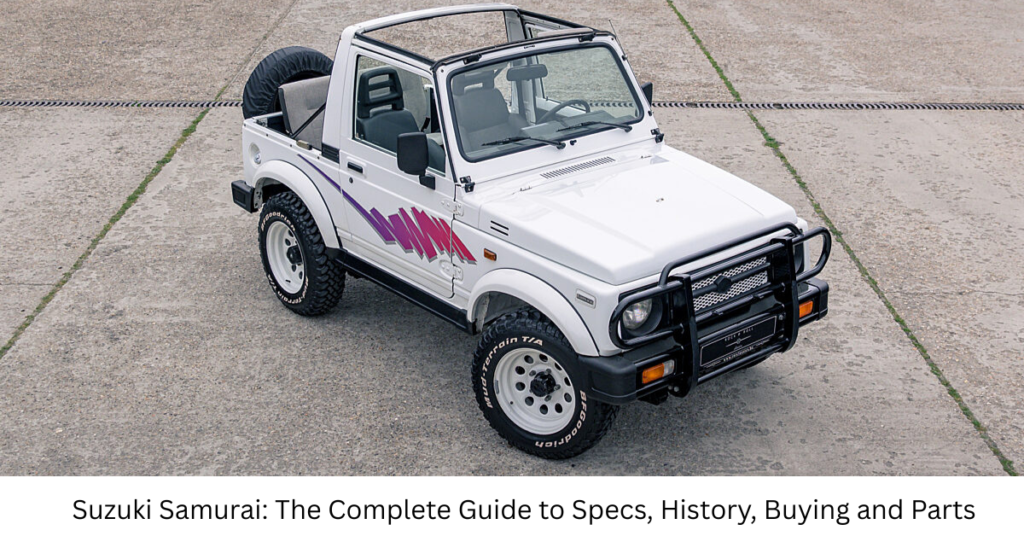

Few small 4x4s have developed the kind of cult following enjoyed by the Suzuki Samurai. It is tiny compared with modern SUVs, relatively basic by today’s standards, and certainly not fast. Yet put one on a rough trail, muddy track, rocky climb, or narrow mountain road, and its simple formula starts to make perfect sense.
The Samurai combined a lightweight body, ladder-frame construction, solid axles, leaf springs, low-range four-wheel drive, and a small four-cylinder engine. In the United States, it was sold for the 1986–1995 model years and became particularly popular among off-road enthusiasts.
Today, these little 4x4s have moved beyond being inexpensive used vehicles. Clean examples are increasingly treated as classic off-roaders, while modified trucks remain popular with enthusiasts who want something simple and highly customizable.
What Is the Suzuki Samurai?
The Samurai was the North American name for the SJ413, part of Suzuki’s long-running Jimny/SJ family of compact four-wheel-drive vehicles. The second-generation SJ platform appeared in 1981, while the 1.3-liter SJ413 arrived in 1984. Suzuki then introduced the Samurai to the U.S. for the 1986 model year.
Unlike today’s crossover SUVs, the Samurai was built around a traditional off-road layout:
- Body-on-frame construction
- Compact two-door body
- 1.3-liter four-cylinder engine
- Five-speed manual transmission
- Part-time 4WD
- Two-speed transfer case
- Leaf-spring suspension
- Solid axles
- Convertible and hardtop body styles
That combination made it exceptionally capable despite its modest size.
In other markets, closely related SJ vehicles were sold under names including Jimny, Sierra, SJ410, SJ413 and other regional names.
Suzuki Samurai History
The Samurai’s roots go back much further than the name itself. Suzuki’s small 4×4 story began with the Jimny family in the late 1960s and early 1970s. Over several generations, Suzuki refined the idea of building a small vehicle that could deliver genuine off-road ability without the weight and complexity of a full-size SUV.
The second-generation SJ arrived in 1981. The smaller SJ410 used a 1.0-liter engine, while the later SJ413 received a 1.3-liter four-cylinder engine and a five-speed gearbox.
The American-market Samurai made its debut for 1986. Its starting price was only $6,200, and Suzuki sold around 47,000 examples during its first year in the United States. Sales climbed even higher during its early years, demonstrating how much demand existed for an inexpensive, lightweight 4×4.
1986 Suzuki Samurai
The 1986 Suzuki Samurai was the first U.S. model year and established the basic formula that would remain for most of the vehicle’s American run.
It used a 1.3-liter eight-valve four-cylinder engine producing roughly 63 horsepower and 74 lb-ft of torque, paired with a five-speed manual transmission.
It was available in convertible and hardtop configurations, giving buyers a choice between an open-air recreational vehicle and something more practical for everyday use.
Because of its low weight and compact dimensions, the Samurai did not need a huge engine to perform well off-road.
1987 Suzuki Samurai
The 1987 Suzuki Samurai is one of the most recognizable versions and is especially interesting to collectors because of the model’s strong early sales.
An 87 Suzuki Samurai retains the basic early-Samurai mechanical layout: a small naturally aspirated four-cylinder, manual transmission, low-range transfer case and leaf-spring suspension.
If you’re looking at a suzuki samurai 1987 today, condition matters far more than the model year alone. Rust, drivetrain condition, previous modifications and evidence of hard off-road use can make a much bigger difference in value.
1988 Suzuki Samurai
The 1988 Suzuki Samurai sits at an important point in the vehicle’s history.
In 1988, Consumer Reports published a highly controversial report concerning the Samurai’s rollover propensity during an avoidance maneuver. The controversy badly affected U.S. sales, and Suzuki later filed a lawsuit against Consumers Union. The legal dispute continued for years before ultimately ending without a monetary award to Suzuki.
The incident became an important part of the Samurai’s history, but it should not obscure the vehicle’s basic characteristics. Like other narrow, short-wheelbase 4x4s, the Samurai requires sensible driving, particularly during sudden steering maneuvers. Suspension lifts, oversized tires and other modifications can also alter its handling characteristics.
Suzuki Samurai Engine and Performance
The Samurai was never designed to win drag races.
Its appeal came from simplicity and off-road gearing rather than outright horsepower. The U.S.-specification vehicle used a 1.3-liter inline-four, with early models using a carburetor and later examples receiving fuel injection.
On the road, that means acceleration is leisurely, particularly at highway speeds. Wind noise, engine noise and the upright body also remind you that this is an old-school utility vehicle rather than a modern SUV.
Off-road, however, the story changes.
The low vehicle weight means the engine has relatively little mass to move, while the transfer case provides low-range gearing for difficult terrain. Its short wheelbase and compact body can also be major advantages on narrow trails.
Suzuki Samurai Weight: Why It Matters
One of the most important characteristics of the vehicle is Suzuki Samurai weight.
A U.S.-market example weighs just under 2,100 pounds in standard form, depending on specification and equipment.
That is extremely light compared with modern SUVs.
The low weight offers several benefits:
- Less mass to carry over difficult terrain.
- Reduced likelihood of sinking deeply into soft surfaces.
- Easier recovery when the vehicle does get stuck.
- Less stress on some drivetrain components.
- Better maneuverability on tight trails.
It also explains why the Samurai can feel surprisingly capable despite its modest engine output.
Suzuki Samurai 4×4 System
This is where the Samurai really earns its reputation.
The standard four-wheel-drive system uses a transfer case with high and low ranges. Drivers can select two-wheel drive for normal road use and engage four-wheel drive when conditions demand it.
Low range is particularly useful for:
- Steep climbs
- Rocky trails
- Mud
- Loose gravel
- Slow technical driving
- Controlled descents
The combination of solid axles, leaf springs, low range and a short wheelbase gives the Samurai a very different character from a modern AWD crossover.
It is not necessarily more comfortable or faster, but it can be remarkably effective when the pavement ends.
Suzuki Samurai Hard Top vs Soft Top
One of the most interesting choices when shopping for an older Samurai is the body style.
Suzuki Samurai Hard Top
The Suzuki Samurai hard top, often called the “tin top” by enthusiasts, provides a more enclosed cabin than the soft-top version.
Advantages include:
- Better weather protection
- More secure enclosed cabin
- A distinctive classic appearance
- Greater practicality in colder or wetter climates
The hardtop became less common later in the U.S. production run, making original examples particularly interesting to collectors.
Soft Top
The soft-top model is arguably the more iconic version. Its removable/open-air character fits the recreational side of the Samurai particularly well.
For weekend trail driving, beach trips and summer cruising, it is hard to beat the personality of an open Samurai.
1990 Suzuki Samurai and Later Models
The 1990 Suzuki Samurai represents the later phase of the U.S. model’s life.
One significant change during the later years was the introduction of throttle-body fuel injection, which replaced the carbureted setup and brought output to around 66 horsepower.
Later vehicles can therefore be attractive to buyers who want some of the Samurai’s classic character without necessarily choosing an early carbureted example.
The hardtop also became less prominent around this period, while Suzuki continued selling the model in the U.S. until 1995.
1992 Suzuki Samurai
The 1992 Suzuki Samurai belongs to the mature part of the U.S. production run.
By this point, buyers were generally purchasing a vehicle with a proven mechanical formula rather than an experimental new model. For someone shopping today, however, a 1992 example should be judged primarily on condition.
Look carefully at:
- Frame rust
- Body corrosion
- Steering components
- Transfer-case operation
- Axle seals
- Transmission condition
- Engine oil leaks
- Suspension bushings
- Previous off-road modifications
A clean, unmodified example can be considerably more desirable than a newer-looking truck that has spent years being heavily modified.
1995 Suzuki Samurai
The 1995 Suzuki Samurai is particularly significant because it represents the final U.S. model year.
Suzuki withdrew the Samurai from the U.S. market after 1995. The larger Sidekick had effectively taken over as Suzuki’s mainstream compact SUV offering in America.
For collectors, final-year examples can be appealing because they are among the newest U.S.-market Samurais available.
However, “1995” alone does not automatically mean a vehicle is valuable. Originality, rust-free condition, maintenance history and drivetrain health are usually much more important.
Buying a Suzuki Samurai Today
Finding a good used Suzuki Samurai is becoming more challenging because many examples have been modified, abused off-road or neglected.
If you’re considering one, don’t rush simply because the vehicle looks cool in photographs.
What to Check Before Buying
1. Frame
This should be near the top of your inspection list. Rust or poorly repaired frame sections can turn an inexpensive project into an expensive restoration.
2. Engine
Listen for unusual knocking, excessive smoke, poor idle quality and signs of overheating.
3. Transmission
Make sure all gears engage properly and check for grinding or unusual noises.
4. Transfer Case
Test both high- and low-range operation if possible.
5. Axles and Driveline
Look for leaking seals, damaged components and excessive play.
6. Suspension
Inspect the leaf springs, shackles, bushings and steering components, especially on modified trucks.
7. Rust
Check underneath the vehicle rather than relying on a clean exterior.
8. Modifications
A quality suspension lift and properly engineered drivetrain upgrades can be useful. Poorly installed modifications, however, can create expensive problems.
Suzuki Samurai Parts and Maintenance
One reason these vehicles remain popular is the availability of Suzuki Samurai parts and the size of the enthusiast community.
The mechanical design is relatively straightforward, which makes many repairs more approachable than they would be on a modern electronically controlled SUV.
Commonly replaced items include:
- Brake components
- Suspension bushings
- Leaf springs
- Steering parts
- Clutch components
- Engine seals
- Cooling-system components
- Axle parts
- Transfer-case components
- Interior trim
- Soft-top components
When buying replacement parts, identify the exact model and market specification first. Not every SJ-series component is automatically interchangeable.
Suzuki Samurai for Sale: What Should You Look For?
Searching for a suzuki samurai for sale can produce everything from unfinished restoration projects to beautifully preserved collector vehicles.
Don’t judge the truck solely by its asking price.
A sensible buying process looks like this:
- Decide whether you want an original truck, restoration project or modified off-roader.
- Check the frame and body for serious rust.
- Verify the drivetrain operates correctly.
- Inspect the underside carefully.
- Review maintenance and restoration records.
- Check whether modifications were professionally installed.
- Compare several vehicles before making an offer.
If you’re searching for a suzuki samurai for sale near me, remember that expanding your search radius can be worthwhile. A rust-free example several hours away may be a much better purchase than a cheap truck sitting nearby that needs major structural repairs.
What About a 1987 Suzuki Samurai for Sale?
A 1987 Suzuki Samurai for sale can be especially tempting because early models have strong collector appeal.
Before buying one, verify that the vehicle has not been heavily altered. An original or sympathetically restored example can offer a very different ownership experience from a truck that has been lifted, cut up and repeatedly used for hard trail driving.
What About a 1995 Suzuki Samurai for Sale?
A 1995 Suzuki Samurai for sale may attract buyers specifically looking for the final U.S. model year.
Again, condition wins.
A well-maintained 1995 model with minimal rust can make more sense than an earlier truck requiring a complete restoration.
What About a New Suzuki Samurai?
People occasionally search for a new Suzuki Samurai, particularly after seeing modern Jimny models and wondering whether Suzuki revived the classic nameplate.
The important distinction is that the original U.S.-market Samurai ended in 1995. Modern Jimny models continue the basic small-4×4 philosophy, but they are not simply a new version of the old U.S.-market Samurai.
So if you’re shopping for a genuinely new vehicle with the Samurai’s basic concept, the modern Jimny is the vehicle family to investigate rather than expecting a brand-new 1980s-style Samurai.
Suzuki Samurai 2020 and Suzuki Samurai 2025 Searches
Searches for Suzuki Samurai 2020 and Suzuki Samurai 2025 can be misleading.
The original U.S. Samurai was not being produced as a new vehicle in either of those years. What people often mean is a modern Suzuki Jimny, a customized older Samurai, or online speculation about a possible revival.
The fourth-generation Jimny launched internationally in 2018, carrying forward the compact 4×4 philosophy in a much more modern package.
So don’t confuse a modern Jimny with an officially revived U.S.-market Samurai.
Is the Suzuki Samurai Still Worth Buying?
For the right buyer, absolutely.
It makes sense if you want:
- A lightweight classic 4×4
- A simple mechanical vehicle
- A serious off-road platform
- A project or restoration vehicle
- A fun weekend vehicle
- A compact vehicle with a huge enthusiast following
It makes less sense if your priorities are quiet highway cruising, modern crash protection, effortless acceleration, advanced driver assistance or luxury.
The Samurai’s charm comes precisely from what it doesn’t have.
Frequently Asked Questions
Is the Suzuki Samurai a good off-road vehicle?
Yes. Its low weight, short wheelbase, solid axles, leaf springs, part-time 4WD and low-range transfer case make it highly capable off-road for its size.
How much does a Suzuki Samurai weigh?
A standard U.S.-market example weighs just under 2,100 pounds, although exact weight varies according to equipment and configuration.
What engine does the Samurai have?
U.S.-market models use a 1.3-liter four-cylinder engine. Early examples were carbureted, while later models received throttle-body fuel injection.
What years was the Samurai sold in the United States?
The U.S. model run covered the 1986 through 1995 model years.
Was there a Suzuki Samurai in 1986?
Yes. The U.S. version was introduced in 1985 for the 1986 model year.
Is the Samurai the same as the Jimny?
They belong to the same Suzuki 4×4 family, but the names vary by market and generation. The U.S.-market Samurai was based on the SJ413, while Jimny and Sierra names were used in other markets.
Are Suzuki Samurai parts still available?
Yes. There is a substantial aftermarket and enthusiast community supporting restoration, maintenance and modification. Availability varies by component and market, so checking compatibility before ordering is important.
Is a Samurai good as a daily driver?
It can be, but expectations need to be realistic. The vehicle is slow, noisy and basic compared with modern SUVs. It is generally better suited to enthusiasts who appreciate its character than drivers seeking modern comfort.
Is a modified Samurai worth buying?
It depends entirely on the quality of the modifications. Professional upgrades can improve capability, while poorly engineered lifts, drivetrain changes or electrical work can create major reliability and safety problems.
Final Thoughts
The Suzuki Samurai is a perfect example of how a vehicle can become more interesting with age rather than less. It was never powerful, luxurious or particularly refined, but its combination of low weight, rugged construction and genuine four-wheel-drive hardware gave it a personality that many modern SUVs simply don’t have.
Whether you’re researching an 1986 Suzuki Samurai, comparing a 1990s example, hunting for a hardtop, looking for replacement parts, or browsing the market for a clean used truck, the same rule applies: condition matters enormously.
A rusty project can consume a budget quickly, while a well-preserved Samurai can provide years of simple, entertaining off-road driving. If you’re considering buying one, inspect the frame, drivetrain and modifications carefully, compare multiple examples, and choose the truck that has been cared for—not simply the cheapest one you can find.
For enthusiasts willing to accept its old-school limitations, that’s still what makes this little 4×4 special.