
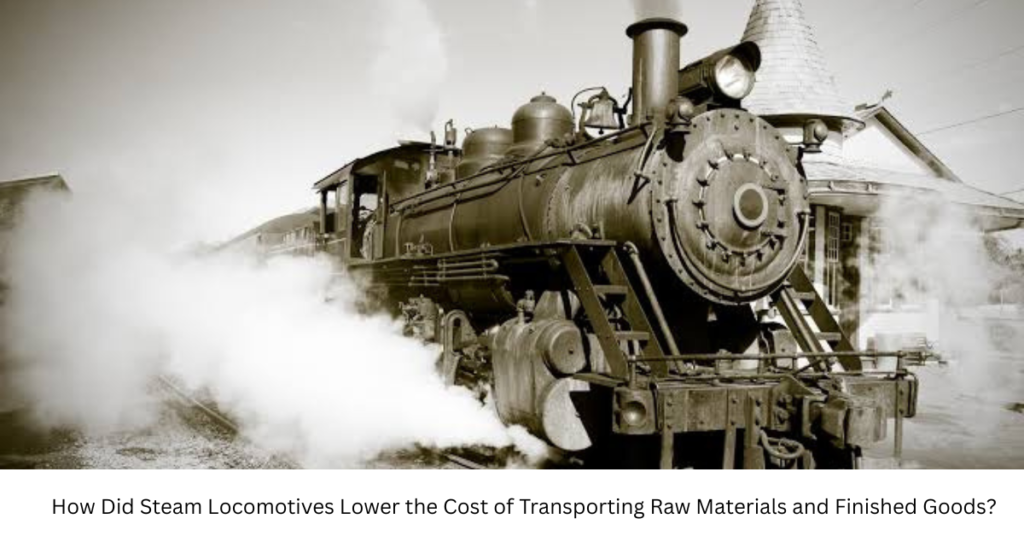

Imagine trying to move tons of coal, iron, timber, or finished products before railways became widely available. Businesses often depended on horses, carts, canals, rivers, and coastal ships. These methods could move goods, but they were slow, expensive, and heavily dependent on geography and weather.
So, how did steam locomotives lower the cost of transporting raw materials and finished goods? The short answer is that they made large-scale land transportation faster, more reliable, and far more efficient.
Steam-powered railways transformed the economics of transportation during the Industrial Revolution. Instead of relying on animal power or waterways, businesses could move heavy loads over long distances at relatively low costs. This helped factories obtain cheaper raw materials, reach larger markets, and produce goods on a much greater scale.
The Transportation Problem Before Steam Railways
Before the widespread development of railways in the 19th century, transporting heavy goods over land was difficult.
Road transportation depended largely on horses, wagons, and carts. A horse could pull only a limited amount, and poor roads could make journeys painfully slow.
Water transportation was generally more efficient for bulky cargo. Canals and rivers could carry substantial quantities of goods, but they had an obvious limitation: they could only go where waterways existed.
Businesses therefore faced several problems:
- High labor and animal costs
- Slow delivery times
- Poor roads and difficult terrain
- Limited transportation capacity
- Seasonal and weather-related disruptions
- Expensive handling when goods had to change transportation methods
Steam railways addressed many of these limitations at once.
Steam Locomotives Made Heavy Transportation More Efficient
One of the biggest advantages of the steam locomotive was its ability to pull a long line of loaded freight cars.
A single locomotive could move far more cargo than a horse-drawn wagon could manage. The energy produced by burning coal could be converted into mechanical motion, allowing railways to transport heavy loads with relatively little labor compared with traditional road transport.
This created an important economic advantage: the cost of moving each individual ton of cargo fell as the size of the train increased.
For industries dealing with bulky commodities such as coal, iron ore, grain, and building materials, this was revolutionary.
More Cargo in One Journey
Instead of sending dozens of separate wagons along a road, companies could place many freight cars behind one locomotive.
This meant:
- One locomotive could replace numerous teams of horses.
- Fewer drivers were required per ton of cargo.
- Large quantities could travel together.
- Loading and unloading could become more organized.
- Businesses could plan shipments more efficiently.
The result was a significant reduction in transportation costs.
Railways Reduced the Cost of Moving Raw Materials
Industrial factories needed enormous quantities of raw materials. Coal powered steam engines and furnaces, while iron ore, timber, cotton, grain, and other commodities fed different industries.
Transportation could represent a major part of the total cost of production.
Steam railways changed that equation.
A factory no longer had to depend entirely on materials available nearby. It could source resources from much farther away while still keeping transportation costs manageable.
For example, an ironworks could receive coal from a distant coalfield by rail rather than depending exclusively on expensive wagon transport.
This encouraged factories to expand production because cheaper and more dependable supplies made large-scale manufacturing more practical.
Faster Transportation Lowered Business Costs
Speed was another major advantage.
A horse-drawn wagon could take days to cover a journey that a railway could complete much more quickly. Faster transportation meant businesses did not have to keep as much inventory sitting in warehouses while waiting for supplies. The main question was how did steam locomotives lower the cost of transporting raw materials and finished goods?
This produced several benefits:
- Factories could receive materials more frequently.
- Manufacturers could respond faster to demand.
- Perishable products had better chances of reaching markets in usable condition.
- Retailers could replenish their stocks more quickly.
- Businesses could reduce the amount of capital tied up in inventory.
Time itself became an economic advantage.
Railways Created More Reliable Supply Chains
Transportation costs are not only about fuel or labor. Uncertainty can also be expensive.
Road conditions, animal health, weather, and seasonal problems could interfere with traditional transportation. Railways offered a more predictable alternative, although early railway systems certainly had their own delays and operational challenges.
Once railway networks became established, companies could schedule shipments with considerably greater confidence.
This reliability encouraged manufacturers and merchants to build businesses around regular deliveries rather than maintaining large reserves of materials simply because transportation was uncertain.
Steam Locomotives Connected Factories With Markets
The benefits did not stop when raw materials reached a factory.
Manufacturers also needed to sell their finished products.
Railways connected industrial centers with towns, cities, ports, agricultural regions, and eventually national markets. A manufacturer could therefore sell products far beyond its immediate local area.
This increased the potential customer base.
A factory producing furniture, machinery, clothing, food products, or construction materials could send its goods to distant markets without relying entirely on expensive wagon transport.
Lower Distribution Costs
When finished goods could be transported cheaply over long distances, the cost of reaching customers declined.
This helped businesses:
- Enter new markets
- Sell products in larger quantities
- Reach urban consumers
- Compete on price
- Expand production
- Develop national distribution networks
In other words, railways did not simply make transportation cheaper. They changed the geographical size of the market available to businesses.
Railways Reduced the Importance of Geography
Before railways, industries often needed to locate close to rivers, canals, ports, or major roads.
Railways changed this.
A factory still benefited from being near transportation infrastructure, but it was no longer restricted to locations directly beside navigable waterways.
Rail lines could be built toward coalfields, mines, ports, industrial districts, and population centers.
This allowed businesses to make location decisions based on a wider range of factors, including labor availability, land prices, access to resources, and proximity to customers.
Economies of Scale Became Easier to Achieve
One of the most important long-term effects of railway transportation was its contribution to economies of scale.
When transportation became cheaper, manufacturers could produce larger quantities and distribute those products across wider markets.
Large factories could therefore spread certain fixed costs—such as buildings, machinery, and management—over a greater volume of production.
The cycle reinforced itself:
Cheaper transportation → larger markets → higher production → economies of scale → lower unit costs.
This was one reason railways became so closely associated with industrial expansion.
How Railways Changed the Cost of Coal and Iron
Coal and iron were particularly important during industrialization.
Coal was needed to power steam engines, heat furnaces, and support many industrial processes. Iron was essential for machinery, tools, rails, bridges, buildings, and other infrastructure.
Both materials were heavy and expensive to move by traditional land transportation.
Railways made it much easier to connect:
- Coal mines with factories
- Iron ore mines with ironworks
- Industrial centers with ports
- Mines with railway construction sites
- Manufacturing towns with consumer markets
Because these commodities could be transported in bulk, railways helped reduce the transportation component of their final cost.
The Railway Itself Created Further Savings
There was an interesting economic feedback loop.
Railways needed huge amounts of coal, iron, steel, timber, and machinery to build and operate the network. As railway demand increased, industries producing these materials expanded.
Higher production volumes could encourage technological improvements and lower costs.
At the same time, cheaper transportation made it easier to supply the railways themselves.
So the railway system became both a product of industrialization and a major driver of further industrial growth.
Rail Freight Compared With Traditional Transportation
The difference becomes easier to understand when looking at the basic characteristics of each method.
| Transportation Method | Typical Strength | Major Limitation |
|---|---|---|
| Horse-drawn wagon | Flexible routes | Limited capacity and high labor costs |
| Canal | Efficient for bulky goods | Restricted to waterways |
| River transport | Relatively inexpensive | Dependent on geography |
| Coastal shipping | Large cargo capacity | Requires ports and suitable routes |
| Steam railway | Fast bulk land transportation | Required expensive infrastructure |
Railways did not make every other form of transportation obsolete. Instead, they became an extremely powerful part of an increasingly interconnected transportation system.
Lower Transportation Costs Helped Consumers Too
The effects eventually reached ordinary consumers.
When manufacturers and merchants could move goods more cheaply, products could be sold in places that were previously difficult or expensive to supply.
Greater competition between producers could also put downward pressure on prices.
Railways helped move everything from food and clothing to coal and manufactured goods. As transportation networks expanded, consumers increasingly gained access to products from distant regions.
The modern idea of a large, interconnected consumer market owes much to these developments.
Railways Also Reduced the Cost of Information and Business Decisions
Although the railway’s most obvious contribution was physical transportation, its wider economic impact was even greater.
Faster movement of people helped businesses communicate and coordinate across greater distances. Railway stations became commercial hubs, while standardized schedules encouraged businesses to think in terms of precise delivery times.
The expansion of railway networks also encouraged the development of more sophisticated logistics, accounting, warehousing, and distribution systems.
In effect, railways helped businesses begin operating on a much larger geographical scale.
Why Steam Locomotives Were More Than Just Faster Engines
It is tempting to explain the railway revolution simply by saying that steam locomotives were faster than horses.
Speed mattered, but it was only part of the story.
Their economic impact came from a combination of:
- High carrying capacity
- Lower labor requirements per ton
- Greater speed
- More predictable schedules
- Ability to travel across land
- Access to distant resources
- Connection to major markets
- Support for mass production
- Lower distribution costs
Together, these advantages changed how businesses thought about production and trade.
The Long-Term Impact on Industrialization
The railway boom helped accelerate industrialization in Britain, Europe, North America, and other regions.
Industries could specialize more heavily because they were no longer dependent solely on nearby customers or resources.
A region could focus on mining, another on manufacturing, and another on agriculture, while railways connected them economically.
This encouraged regional specialization and national trade.
It also helped cities grow around railway junctions, industrial centers, ports, and manufacturing districts.
Frequently Asked Questions
How did steam locomotives reduce transportation costs?
Steam locomotives reduced costs by pulling large quantities of cargo in a single train, reducing the amount of labor and animal power needed per ton. They also provided faster and more reliable transportation over land.
Why were railways important for raw materials?
Railways allowed heavy materials such as coal, iron ore, timber, and grain to travel economically over long distances. This gave factories access to resources that might previously have been too expensive to transport.
How did railways affect the price of finished goods?
Lower freight costs made it cheaper for manufacturers to distribute products to distant markets. Larger markets also allowed factories to increase production and benefit from economies of scale, potentially reducing unit costs.
Were steam locomotives cheaper than canals?
Not necessarily in every situation. Canals could be extremely efficient for certain bulk goods, particularly where suitable waterways already existed. Railways’ major advantage was their flexibility and ability to transport goods across land without depending on navigable waterways.
How did railways contribute to the Industrial Revolution?
Railways connected mines, factories, ports, farms, and cities. By lowering transportation barriers, they supported larger-scale production, expanded markets, encouraged specialization, and accelerated industrial growth.
What goods were commonly transported by steam railways?
Common freight included coal, iron, steel, grain, timber, agricultural products, manufactured goods, construction materials, and other industrial commodities.
Did steam locomotives completely replace other forms of transportation?
No. Canals, ships, wagons, and later motor vehicles continued to play important roles. Railways became one part of a broader transportation network in which different methods served different purposes.
Conclusion
So, how did steam locomotives lower the cost of transporting raw materials and finished goods? They combined high carrying capacity, relatively efficient use of labor and fuel, greater speed, dependable land routes, and access to much larger markets.
For manufacturers, this meant cheaper access to essential raw materials. For merchants, it meant lower distribution costs and wider customer bases. For consumers, it eventually meant greater access to products from distant regions.
Most importantly, railways helped break down the transportation barriers that had limited industrial growth for centuries. They did not simply make trains faster than horse-drawn wagons—they helped create an interconnected industrial economy in which resources, products, workers, and markets could move across much greater distances.
For anyone studying the Industrial Revolution, transportation history, or the development of modern supply chains, the rise of steam railways is a perfect example of how a change in technology can reshape an entire economy. This was all avout how did steam locomotives lower the cost of transporting raw materials and finished goods?