
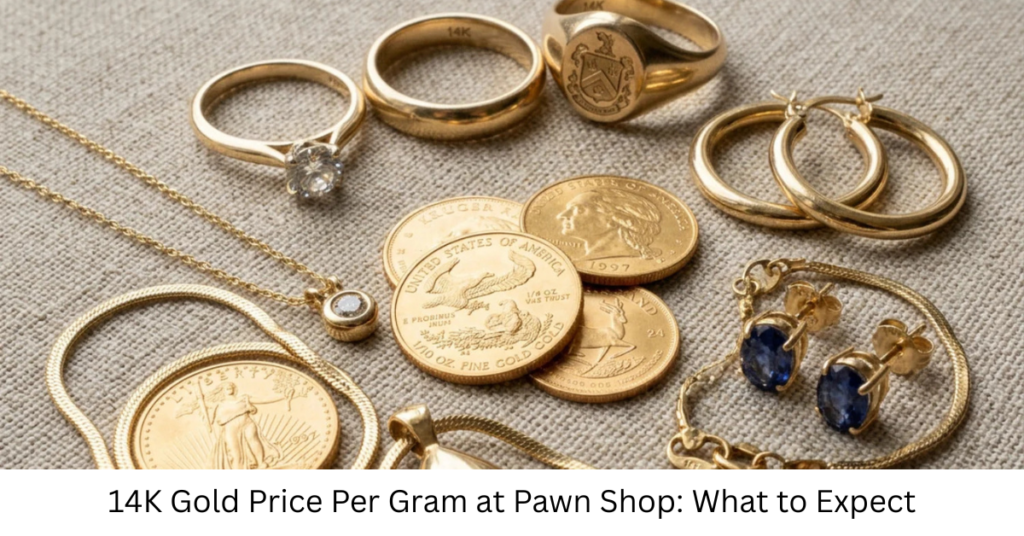

Gold jewelry can look simple, but figuring out what it is actually worth at a pawn shop is a little more complicated. If you’re searching for the 14k gold price per gram at pawn shop, the first thing to understand is that there isn’t one universal rate.
A pawn shop’s offer depends on the current gold market price, the item’s weight, its purity, and the shop’s own lending or buying margin. A 14K chain weighing 10 grams, for example, won’t necessarily receive the same offer at two different pawn shops.
This guide explains how the calculation works, what you can realistically expect, and how to avoid accepting an unnecessarily low offer.
What Is 14K Gold?
14K gold contains approximately 58.5% pure gold, with the remaining metal consisting of alloys such as silver, copper, zinc, or other metals. You may see 14K jewelry stamped 14K, 14KT, or 585.
The “14” in 14K refers to 14 parts of gold out of 24:
14 ÷ 24 = 0.5833
In commercial jewelry, 14K is commonly treated as approximately 58.3%–58.5% gold, depending on the standard and testing method.
That distinction matters because a pawn shop isn’t valuing the entire weight of your jewelry as pure gold.
14K Gold vs. Other Karats
| Gold Type | Approx. Gold Content |
|---|---|
| 10K | 41.7% |
| 14K | 58.3–58.5% |
| 18K | 75% |
| 22K | 91.6% |
| 24K | 99.9%+ |
Generally, the higher the karat, the more pure gold the item contains and the higher its metal value per gram.
How Is the 14K Gold Price Per Gram at Pawn Shop Calculated?
Pawn shops generally start with the value of the actual gold content rather than the retail price you originally paid.
A simplified calculation looks like this:
Weight × 14K purity × current 24K gold price per gram = approximate melt value
For example, suppose you have a 10-gram 14K gold bracelet.
10 × 0.585 = 5.85 grams of pure-gold equivalent
If pure gold were trading at $100 per gram, the theoretical melt value would be:
5.85 × $100 = $585
But that does not mean a pawn shop will necessarily give you $585.
Pawn shops need to account for refining, testing, operating expenses, resale risk, financing costs, and profit. Industry explanations commonly describe pawn offers as a percentage of melt value rather than the full theoretical metal value.
Why Pawn Shops Pay Less Than the Gold Spot Price
This is where many first-time sellers become confused.
The gold spot price is essentially the market reference price for gold, generally quoted for pure gold. Your 14K jewelry contains only around 58.5% gold.
Then there is the melt value, which estimates the value of the recoverable gold in the item.
Finally, there is the pawn shop offer, which is the amount the business is actually willing to lend or pay.
These three numbers can be very different.
Spot Price vs. Melt Value vs. Pawn Offer
Think of it this way:
- Spot price: Current market value of pure gold.
- Melt value: Estimated value of the gold contained in your jewelry.
- Pawn offer: What the shop is prepared to give you after considering its costs and margin.
This is why searching for a single “price per gram” can be misleading.
What Determines Your Pawn Shop Gold Offer?
Several factors can influence the amount you’re offered.
1. Current Gold Market Price
Gold prices change constantly. Therefore, an offer that looks attractive today could look quite different several weeks later.
If you’re planning to sell or pawn gold, check the current gold price on the same day you get your appraisal.
2. Gold Purity
A 14K item contains substantially less pure gold than an otherwise identical 18K or 22K item.
The shop will test or verify the karat before calculating the offer.
3. Weight
Weight is another major factor.
A 2-gram 14K ring naturally contains less gold than a 20-gram 14K chain. However, the scale weight isn’t always equal to the amount of gold being valued.
Stones, clasps, non-gold components, and other materials may be excluded or treated differently during appraisal.
4. Type of Transaction
There’s an important difference between pawning and selling.
When you pawn an item, the shop provides a loan against the jewelry, and you normally have the opportunity to repay the loan plus applicable charges and reclaim it.
When you sell gold outright, ownership transfers to the buyer.
Don’t assume the two transactions will produce exactly the same figure.
5. The Individual Pawn Shop
Two shops can appraise the same piece differently.
Their policies, local demand, risk tolerance, operating costs, and expected resale value can all affect the final offer.
For that reason, comparing offers from multiple reputable buyers can be worthwhile.
What Is the 14K Gold Price Per Gram at Pawn Shop Near Me?
If you’re searching for the 14k gold price per gram at pawn shop near me, don’t rely solely on a Google result showing a generic price.
The better approach is to call or visit several nearby pawn shops and ask:
- What is your current 14K gold rate?
- Do you buy 14K gold or only accept it as collateral?
- Is the quoted price based on gross or net gold weight?
- How do you test the karat?
- Are stones and non-gold parts deducted?
- What fees or interest apply if I’m pawning it?
- Is the quote valid today?
Getting these answers can reveal why one shop’s offer is higher than another’s.
How to Calculate an Approximate 14K Gold Value Yourself
You don’t need specialized equipment to get a rough estimate before visiting a pawn shop.
Step 1: Find the Weight
Use a jewelry scale that measures grams.
For example:
Jewelry weight = 8 grams
Step 2: Determine the Purity
For 14K gold, use approximately:
8 × 0.585 = 4.68 grams of pure-gold equivalent
Step 3: Check the Current Pure Gold Price
Suppose the current 24K gold price is hypothetically $100 per gram.
Then:
4.68 × $100 = $468 melt value
Step 4: Compare the Pawn Offer
The actual offer could be below that theoretical melt value because the pawn shop needs room for its costs and profit.
The important point is that $468 is not automatically your cash offer. It’s an illustration of how the underlying metal value can be estimated.
How Much Will a Pawn Shop Pay for 14K Gold?
There is no reliable universal percentage that applies to every pawn shop.
Some industry sources describe pawn or scrap-gold offers in broad ranges such as 50%–80% of estimated melt value, while individual shops may offer more or less depending on the item and local market.
A useful way to think about the process is:
Estimated melt value × shop’s payout percentage = approximate offer
For instance, if a piece has an estimated melt value of $600:
- 50% offer = $300
- 60% offer = $360
- 70% offer = $420
- 80% offer = $480
These are illustrative calculations, not guaranteed pawn-shop rates.
14K Gold Price Per Gram at Pawn Shop Philippines
The situation can be slightly different when you’re looking at the 14k gold price per gram at pawn shop Philippines because pawnshops may quote values in Philippine pesos and use their own appraisal systems.
Large Philippine pawnshops offer gold pawning services, but the exact loan amount depends on their appraisal rather than simply multiplying the item’s weight by an online gold price. For example, Palawan Pawnshop states that genuine gold jewelry is accepted as pawn collateral and that appraisal is part of its pawning process.
If you’re in the Philippines, don’t confuse:
- retail jewelry price,
- gold market price,
- pawnshop appraisal,
- loan amount, and
- eventual selling price.
These can all be different.
It’s also useful to compare branches or competing pawnshops because appraisal policies and offers can vary. Community reports from Philippine gold owners similarly emphasize comparing multiple appraisals rather than assuming one shop’s quotation represents the entire market.
Does Jewelry Design Affect the Price?
It can.
If you’re selling gold strictly for its metal value, a simple gold chain and a heavily decorated piece may ultimately be valued mainly according to their recoverable gold content.
However, some jewelry has additional resale value because of:
- Brand name
- Designer craftsmanship
- Vintage appeal
- Rare designs
- Gemstones
- Collectibility
- High-quality construction
Before accepting a scrap-style offer, ask whether the shop is valuing your piece as jewelry or primarily as gold.
A branded or collectible piece could potentially be worth more than its melt value.
What About Gold-Plated or Gold-Filled Jewelry?
This is extremely important.
A piece that looks like gold isn’t necessarily solid 14K gold.
You may encounter:
- Gold plated
- Gold filled
- Gold vermeil
- Gold-tone jewelry
- Solid 14K gold
Gold-plated jewelry has only a thin layer of gold over another metal, so it shouldn’t be valued like a solid 14K piece.
Look for purity marks such as 14K, 14KT, or 585, but don’t rely on a stamp alone. Professional testing may still be required to verify the metal.
How to Get the Best Pawn Shop Offer
If you’re serious about getting a fair price, preparation can make a difference.
1. Know the Approximate Weight
Weigh your jewelry before visiting the shop.
2. Check the Hallmark
Look inside rings, near clasps, on the back of pendants, or other less visible areas for markings.
3. Check the Gold Market
Know approximately where gold is trading before you negotiate.
4. Get Multiple Quotes
Don’t automatically accept the first offer.
Try two or three reputable businesses and compare the figures.
5. Ask for the Calculation
A reputable appraiser should be able to explain how they arrived at the offer.
6. Separate Sentimental Value From Scrap Value
If the jewelry belonged to a family member, its emotional value may be much higher than its gold value.
Don’t sell something irreplaceable simply because the immediate offer looks attractive.
Selling vs. Pawning: Which Is Better?
The right option depends on your circumstances.
Pawning may make sense if:
- You need short-term cash.
- You want the possibility of getting the jewelry back.
- You expect to repay the loan within the agreed period.
Selling may make more sense if:
- You don’t want the jewelry anymore.
- You don’t want to pay interest or loan charges.
- You want to compare outright purchase offers.
Before pawning, make sure you understand the interest rate, repayment deadline, renewal rules, and consequences of non-payment.
Common Mistakes People Make
Avoid these mistakes when taking 14K jewelry to a pawn shop:
- Assuming the retail purchase price determines today’s value
- Assuming 14K means 100% gold
- Comparing your jewelry’s value with the 24K spot price
- Accepting the first offer without comparison
- Forgetting that stones and non-gold parts may affect weight
- Not asking whether the quote is for a loan or outright purchase
- Ignoring interest and other pawn-related charges
- Assuming every “gold-looking” item is solid gold
The more you understand the calculation, the easier it becomes to recognize a reasonable offer.
Frequently Asked Questions
How much is 14K gold worth per gram?
There isn’t a fixed worldwide price. The theoretical metal value is approximately 58.5% of the current 24K gold price per gram, while a pawn shop normally offers less than the full melt value.
Do pawn shops pay full gold value?
Usually, no. Pawn shops need to cover testing, operating costs, risk, financing, refining, and profit. Their offer is therefore generally below the theoretical melt value.
Is 585 gold the same as 14K?
Generally, yes. A 585 marking indicates approximately 58.5% gold, which corresponds to 14K gold.
Does a 14K gold stamp guarantee the jewelry is real?
No. A hallmark is useful evidence, but professional testing is a better way to verify purity, particularly for valuable jewelry.
Why is my pawn offer lower than the online gold price?
Online gold prices generally refer to a market price for gold, often pure gold. Your jewelry is 14K, contains other metals, and the pawn shop must also maintain a margin.
Should I get more than one appraisal?
Yes. Comparing several reputable buyers or pawnshops can help you understand whether the first offer is competitive.
Is pawnshop gold cheaper than new jewelry?
Often, secondhand jewelry can be priced differently from new jewelry because new jewelry includes manufacturing, design, retail, and other costs. However, each item should be evaluated individually.
What is the best way to find a pawn shop near me?
Search for established pawnshops in your area, check their reviews, and contact several businesses before visiting. Ask specifically about their current 14K gold appraisal or buying rate.
Final Thoughts
The 14k gold price per gram at pawn shop isn’t a single number that applies everywhere. The amount you receive depends on the current gold market, your jewelry’s actual weight and purity, the type of transaction, and the individual pawn shop’s pricing policy.
The smartest approach is to calculate an approximate melt value first, understand that the pawn offer will usually be lower, and then compare several reputable buyers.
If you’re considering selling or pawning a valuable piece, don’t rush. A few minutes spent checking the gold price, verifying the karat, understanding the weight, and comparing offers could make a meaningful difference in how much you receive.
Note: Gold prices change frequently, and pawnshop offers are location- and business-specific. The calculations above are intended to explain the valuation process rather than provide a guaranteed cash price.